Showing posts with label Namibia Wildlife. Show all posts

Tuesday, May 22, 2018

Dik-Dik of Namibia


The Kirk's dik-dik  is a small antelope native to Eastern Africa and one of four species of dik-dik antelope. It is believed to have six subspecies and possibly a seventh existing in southwest Africa. Dik-diks are herbivores, typically of a fawn color that aids in camouflaging themselves in savannah habitats.  They are also capable of reaching speeds of up to 42 kilometers per hour. The lifespan of Kirk's dik-dik in the wild is typically 5 years, but may surpass 10 years.  In captivity males have been known to live up to 16.5 years, while females have lived up to 18.4 years.

Dik-diks are some of the world's smallest antelopes, with the largest, the Kirk's dik-dik, standing between 14 and 18 inches tall and weighing no more than 7.2 kg. Female dik-diks tend to be 1 to 2 pounds heavier than males. Dik-diks are dainty creatures with a pointed, mobile snout, large eyes and ears, prominent preorbital glands, pipestem legs, hare-like hind limbs that are significantly larger than their forelimbs, and a vestigial tail. Their coats, depending upon their habitat, range from grey to gray-brown with tan flanks, limbs, and an erectile head crest and whitish eye rings, ear lining, underparts, and rump".


Similar to other dwarf antelopes, Kirk's dik-diks exist in monogamous pairs on territories. Territories are marked with dung and urine that are deposited in a ritual that is performed to help helps maintain pair bonds. During the ritual, the female will excrete, followed by the male, which samples the female's urine stream to check her reproductive capacity. He paws over and then marks his dung and urine over her deposit. Finally, the pair marks nearby twigs with secretions from their pre-orbital glands. Kingon 1982 states that, "The male courts the female by running up behind her with his head and neck stretched and his muzzle pointing out in front. Copulation begins with the male standing on his hind legs behind the female and waving his forelegs at an acute angle to his own body in the air over her back". Copulation typically occurs anywhere between three and five times within a 9-hour period.


Wednesday, March 14, 2018

Living Desert Adventures


The Living Desert Tour, originally developed in the 1990’s, is a unique 4x4 adventure drive through the dunes outside Swakopmund, Namibia. Just the drive in the dunes is an amazing experience, but it will show you a lot more than sand. The tour takes you from the vegetated, life-rich eastern side of the dunes, right through the dunes to the Atlantic Ocean on the western side of the dune belt. 

Introducing you to some of the fascinating, hidden life in this apparently barren landscape that is part of the Namib Desert. Here you can find creatures endemic to the Namib: the sidewinder (Peringuey's Adder), the Palmato Gecko with its transparent skin and beautiful colours - we dig into the dune side to find this nocturnal desert-dweller. We track the large Namaqua Chameleon, and watch it enjoy brunch. Then it's a dash to catch the swift sand-diving lizard. 

Finding out how the area's plants and small animals survive the harsh climate, and how they obtain water for life. You will also track a FitzSimon's Burrowing Skink across the dune face, in hopes of catching this legless lizard. Along the way, they will explain the variety of dune colours. At the end of the tour, weather permitting, you will experience a 'roaring' dune. 

Other characters to be found in the dune belt are the 'dancing' White Lady Spider; the Parabuthus Villosus black scorpion; the occasional horned adder or sand-snake; desert wasps, fish-moths, crickets and several beetle species, and many more. 

The Living Desert Tour is educational, fun and an unforgettable experience. You will see the desert and dunes with new eyes. The photographic opportunities are endless too: make sure those batteries are charged before you leave! 


Tuesday, November 21, 2017

The Famous Ongava Game Reserve..

Ongava Lodge    
     
The well-established Ongava Lodge is situated in the privately owned Ongava Game Reserve along the southern boundary of Etosha National Park. Placed as it is close to the top of a hill in the foothills of the Ondundozonanandana range, the vantage point is beautiful and overlooks a well-frequented waterhole and the plains beyond.
Ongava Lodge offers luxury accommodation in 14 rock-and-thatch en-suite chalets. There are impressive views over the camp’s waterhole from the main lounge and dining areas and there is also an inviting pool to cool off in the heat of the day. Meals are either served in the main dining area under thatch or on the dining deck under the stars.

Activities include game drives into Etosha, spending time in the camp hide, and nature drives and walks on the reserve. Ongava has resident white and black rhino, giving guests staying at Ongava the opportunity to see both species.


Little Ongava

Little Ongava is perched on the crest of a hill commanding magnificent vistas of the plains stretching for miles to the horizon, offering an extraordinary experience as the focal point of an Etosha journey.
This intimate camp has only three spacious suites each with its own plunge pool, en-suite bathroom, “sala”, and outdoor shower. The lounge and dining areas have wonderful views of a productive waterhole below the camp, the open deck allowing for relaxed, stylish dining under the African sky. Guests at Little Ongava share a dedicated guide and vehicle, ensuring the best possible nature experience at one of Africa’s great wildlife destinations. Day and night wildlife-viewing drives, visiting hides overlooking waterholes, walks and rhino tracking with experienced guides can all be enjoyed exclusively on this reserve. Game drives and day trips into nearby Etosha National Park are also offered.


Ongava tented Camp

The classic safari style camp is tucked in a hidden valley at the foot of a dolomite hill in Ongava Game Reserve bordering Etosha National Park.
Eight large comfortable Meru-style tents all have en-suite facilities, open air showers and private verandas; the family unit sleeps four. The main area, built of stone, canvas and thatch, fronts onto a much-frequented waterhole; watching wildlife coming to drink from here or from the swimming pool is a favourite pastime.
Ongava’s proximity to Etosha allows for game drives in the Etosha National Park and on the Ongava Reserve itself. Other possibilities include guided walks, birding and visiting hides. Ongava holds one of the largest rhino custodianships for the Namibian government in the country and is one of the few private game reserves in southern Africa where guests can see both black and white rhino.


Andersson's Camp

Nestled in mopane scrub on white calcrete soils, Andersson’s Camp is situated 4.5 km from Etosha’s Andersson Gate. The camp was named after Swedish explorer Charles Andersson – one of the first Europeans to “discover” Etosha, Africa’s largest saltpan.
The resurrected former farmstead that stands on the site now forms the centre of a charming camp fronting onto a productive waterhole. The 18 tented en-suite units (including two family suites) are raised on decks. The camp is an exciting example of sustainable construction; this model of eco-sensitive lodging provides an authentic, safe and down-to-earth experience for small groups, families and independent travellers to the Etosha region and is easily accessible by either road or air.
Activities include morning and/or afternoon game drives in Etosha National Park, and morning and afternoon/evening drives (on request in camp) and nature walks on Ongava Reserve. The sunken hide at the waterhole in front of camp is an excellent place from which to watch wildlife coming down to drink.


Ongava Wildlife


Wednesday, September 20, 2017

Everything is exciting about Lake Oanob.

The Lake Itself...


Situated on 6200 hectares in the beautiful Hardap Region and only 100 kilometres south of Windhoek. Open all-season, Lake Oanob Resort offers superb lake views, genuine, heart-felt hospitality and is the perfect place to relax and be invigorated.

Accommodation...


The Lake Oanob Resort offers many different types of accommodations. From Luxury Chalets to En-Suite rooms and Family Rooms over to a Special Suite and different Campsites as well. Most of our accommodation are situated by the Lake site.

Activities...


Some activities you can enjoy year-round include game drives, hiking, boat rides, canoeing, aqua cycling, giraffe pool bar, swimming in our outdoor pools or in the lake.


Thursday, April 21, 2016

Affordable luxury at the Entrance to Etosha National Park

Etosha Village

Prime destination for nature lovers combined with excellent service and cuisine! Etosha Village, uniquely combines affordability with comfort and delivers the perfect safari style experience in a private and protected reserve directly adjacent to the Etosha National Park, near Okaukuejo.
At Etosha Village nature and luxury are in perfect harmony through design and comfort. Besides the 40 accommodation units and Camping facilities, Etosha Village has three restaurant seating areas, a unique bar with a big screen television, a sparkling pool plus two kiddies pools as well as a well-stocked utility and curio shop.
The individual canvas suites offer a fully air-conditioned bedroom with a unique semi-open en-suite bathroom and a patio to enjoy the beauty that surrounds you.
The Etosha Village Camp Site is nestled in the spectacular green and gold Mopani forests surrounding Etosha National Park, and caters for both Groups as well as individual travellers.

The Etosha Village Camp Site is nestled in the spectacular green and gold Mopani forests surrounding Etosha National Park, and caters for both Groups as well as Individual travellers.

The 2 spacious Group Camp Sites are ideal for larger groups and can accommodate a maximum of 25 – 30 tents. These sites are equipped with Power Outlets, Running Water, Lights, Barbeque area and separate Ladies and Gents Bathroom facilities each featuring toilets, wash basins and showers.
The 4 Individual Camp Sites are also equipped with Power Outlets, Running Water, Lights, Barbeque and a well-kept shared ablution. 


Inspiring cuisine can be enjoyed at the Etosha Village Restaurant situated walking distance from the Camp Site. On-site facilities include swimming pools and a bar area with a big-screen television as well as a fully stocked utility and curio shop. Guided excursions to Etosha and sundowner drives can also be booked at reception.

Tuesday, March 8, 2016

Namibia Reservations has compiled a Bucket List

We here at Namibia Reservations have compiled a Bucket List for all travelers wanting to miss nothing spectacular of Namibia.  In our Bucket List, there are the highlights, but you can never see enough of our beautiful country Namibia.  Enjoy!

1.  Houseboat Safari on the Zambezi
Traveling on a houseboat is a rare experience.   Sleeping among the hippos and crocodiles will be a number one for most of our team.


2. Swakopmund Sky dive
Skydiving is something that actually can be done anywhere, however in Swakopmund you have a unique setting.  The thrill of jumping out of a plane curls my toes as I think about it, having the dunes on your right and the ocean on your left.  The mental picture you make of that can never be captured onto a photo.  


3. Walvis Bay / Swakopmund Catamaran
Experiencing the Namibian coast in-depth on a Dolphin or Seal cruise has to be on any tourists Namibian Bucket List.  Not only will you see different types of sea animals, you will also have the chance to taste one of our delicacies the oyster.  On a cruise they serve raw oysters from the shell, sprinkled with a bit of roughly ground black pepper and splashed with a dash of Tabasco sauce.   This is one of my favorite things of a cruise, other than seeing dolphins and whales.  It does not matter how many times I see a dolphin, I can never get enough of these gorgeous animals.


4. Damaraland Camping
Damaraland is the most scenic areas in Namibia, that offers the traveler a most adventurous challenge.  From open plains and grasslands to sandy wastes.  Here you will see Desert animals and the Damara people who inhabit this land.  Camping here, you will experience the open starry skies of Namibia.  No lights objecting your view, this is where dreams come true.  


5. Ballooning over the Sossusvlei
This one is on my own Bucket List, this is a once in a life time opportunity. The Sossusvlei has been rated one of the most spectacular sites of Namibia.  Taking this safari at dusk or just before sunrise you will experience strong colors that are constantly changing.  On this safari don't forget to take your camera along, as this is a great photographic opportunity.


6. Etosha National Park
This might be an old destination but most common.  I have been to Etosha, but I will go back as many times as I can.  Seeing so many animals in one place is remarkable and only in Namibia.  This is absolutely an animal lovers haven.  Seeing how the lions lie around waterholes, how the elephant stand around or walking across the road right in front of you.  How the giraffes stretch to get to the highest leaves on the trees.  What I love most about Etosha is the fact that these animals are not bewildered at all.  Elephants come as close a 5 feet or even closer.  Etosha will stay on my list and no matter how many times I have been there I will always want to go back.


7. Where the Namib meets the ocean
The cold waters of the sea brushing against the dunes of the Namib desert is one of the most surreal sights.  This is a personal favorite of Magret Mtleni, one of our top achieving consultants.  With the most spectacular dunes in the world, raging from pink to vivid orange this scene has Magret's heart sobbing over this beauty.


8. Waterberg climb
Reaching high over the plains of Namibia is the Waterberg Plateau, a 20-kilometer by 50-kilometer table mountain massif made of porous sandstone that soaks up moisture. Rainwater that drips through the stone top collects on a solid layer of clay beneath, and the water that runs off creates springs on the southeast side of the plateau. I encourage travelers to climb to the top of Waterberg to experience the entire area.  Soak it all in!


9. The Caprivi
After I asked our team the hardest question you could ask "Where would you travel if you could and what would you like to see in Namibia?"  After taking into consideration ALL of Namibia, they feel they would like travelers to definitely see the Caprivi.  Staying one night is not enough.  For me, Top 3 most beautiful landscapes of Namibia is the Caprivi.  The nature, the bush, the animals, the river, the...beauty!  Experience true Africa with the abundance of hippos, elephants and buffalo.  The wetlands are a must on the Bucket List.


10. Erindi Private Game Reserve
Here, the home of the Big 5!  I cannot recommend Erindi enough to anyone who has a passion for wild life and wild life photography you will leave as inspired as I was.


Well there it is! The Top 10.  If I don't stop now, I'm afraid I will never stop as Namibia will never get old and you will never see enough of this remarkable place.


Realizing now I think I missed to mention an ultimate for me:  At Nr. 11, I have the sunset of Namibia.  Nowhere else have I experienced a sunset as spectacular as a truly Namibian sunset. Whether it is standing on the Waterberg, sunset over the dunes, or sunset in Swakopmund.  I advise you leave your camera in it's bag till you have soaked it all in.  Drink in the beauty before capturing the memory forever.  


Thursday, February 25, 2016

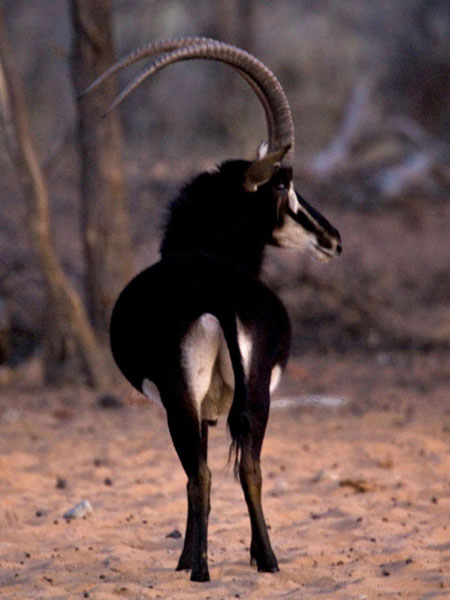
Have you any idea how beautiful Namibian Sable are??


The sable (Hippotragus niger) are less robustly built and lighter in mass than their close relatives the roan. It is a horse-like antelope with a long mane and easily identified by their distinctive swept-back horns. They are a savannah woodland species, dependent on cover and the availability of water. They prefer open woodland or grassland with medium to high stands of grass and avoid woodland with a high density of trees or where the grass is short. 

Sable are gregarious and herds of 20 to 30 are common, with larger temporary aggregations of up to about 200. They may fall prey to lion, but most predators attack with caution.

Sable occur in the north-eastern parts of Namibia, mainly the Zambezi Region (formerly the Caprivi Strip) and they have also been introduced into Waterberg Plateau Park and can be found around the newly opened Dolomite Camp in Etosha National Park

Friday, September 25, 2015

Sandfontein where relaxation comes naturally

Sandfontein Lodge & Nature Reserve is a private hideaway in Namibia with magical mountain scenery and just five eco-conscious bungalows. With epic river views and scorched, rocky landscapes that extend as far as the eye can see, Sandfontein is a nature reserve like no other.


Enjoy a romantic lunch by the pool, the choice is simple: set out to discover the reserve’s incredible plants and creatures, or spend an indulgent hour or two in the cosy main lodge building, where mountain views flood into the soulful bar area.


Animals

Of all the animals at Sandfontein, most impressive are the illusive wild leopards, which stalk the land in search of prey. Antelope species seen on the reserve include eland and kudu, a solitary creature that spends much of its time in the mountains.

 Activities 
Scenic Drives
Nature Trails
Fishing on the River
Spa Treatments
Sundowner

                     
 Sandfontein is a place where relaxation comes naturally. 

For more information please contact us at