Showing posts with label Family Holiday. Show all posts

Thursday, December 15, 2016

Christmas is Namibia

Christmas is a tradition celebrated across the world. Not all traditions are the same and not all countries celebrate it on the 25th of  December.Some countries don’t even celebrate it at all. In Japan, Akihoto is an emperor who celebrates his birthday on 23 December. His birthday is a National Holiday but not 25 December. In Georgia, Christmas is celebrated on the 7th of January, which is 25 December on the Julian Calendar. Everywhere in the world, Christmas means something else to each and everyone. To you it may mean getting together with your family around a big table with laughter and delicious food, but to the man with no shoes, begging on the street corner, it’s just another day with no hope for tomorrow. To a child it’s the excitement of the new toys he can play with, but to a mother who lost her child earlier this year, it’s just a day of pain. I’m not trying to evoke an emotion of pity, this is just reality. It’s the time of year we all get overly emotional. Are you planning to spend Christmas in Namibia and want to know how its done? You are welcome to use some of the tips and ideas for your celebrations.

The celebrations 
German Christmas celebrations are held on the 24th of December. The Christmas meal is one of the most important parts of the celebration. It is prepared with the utmost care and effort. The presentation of the table is an elegant affair and family and friends are invited to join this special meal. A variety of Christmas cookies which are known as Weihnachtsplätzchen are made especially for the day, like : Lebkuchen – traditional German gingerbread, Bethmännchen – traditional marzipan cookie, and Dominosteine – Gingerbread with marzipan & chocolate.
The Oshiwambo Christmas is also a feast. They believe Christmas is about sharing. You can go from house to house and drink traditionally made drinks. Big celebratory braais (barbeques) are held and everyone is invited. Families drive 100s of kilometers to get together for this very special day.

The Caprivian Christmas has one very important factor. Church. Christmas day is started off with a church service. On this day you wear the most expensive dress or suit that you own and it is usually not your everyday attire. It is a garment that stays in your cupboard for special occasions. Most people in these areas do not earn a lot of money so these outfits they have, are extra special. Months of savings money have been used to afford it. Every family prepares a traditional meal for a sit-down dinner.

The Herero traditional Christmas is focused very much on the young ones. The children have to practice a play before Christmas, and on the day, perform this play for the adults. A feast of delicious cuisine and singing follows.

Tuesday, July 12, 2016

New kids’ conservation materials at Gondwana


Gondwana Game Reserve has introduced new custom kids’ conservation materials.


“A booklet is given to all children visiting Gondwana to complete with their field guide on game drives and in our various Junior Ranger modules. They include learning to track and making a mould of an animal track,” said Wendy Rutherfoord, Director.

Other activities that children could enjoy include making their own fishing rod and fishing in one of Gondwana’s many waterholes, learning how to analyse dung samples to better understand what various animals eat, and making crafts with the indigenous fynbos.

“Junior Rangers fill in a registration card at check-in to which we then add a photo with their ranger at the end of their stay and it becomes a nice memento to take home,” adds Rutherfoord.

Thursday, June 23, 2016

Tour you can't miss!! - Namibia Reservations

FACES of the NAMIB - To book this tour contact us at info@namibiareservations.com


Discover this desert’s unique treasures…

A world of infinite horizons, dramatic vistas and fascinating flora and fauna…

Reported to be the oldest desert on earth, the Namib is approximately 80 million years old.  Completely devoid of surface water, it is bisected by several dry riverbeds and is characterised by extensive, undulating dunes. The Sahara may be larger and Gobi more isolated, but the Namib is the very oldest, so on this trip, prepare for the best desert experience possible!

The Living Desert:  At first glance, the Namib’s interior appears totally devoid of fauna & flora but look closely and you’ll finds that apart from the diamonds and uranium that have been mined here, the desert’s unique plant and animal life is definitely another of its infinite treasures. One outstanding living wonder is the famous Welwitschia mirabilis, a plant that can live for up to five hundred years. Although its tenacity and longevity are remarkable, the fact that it has the appearance of a heap of garden refuse means that instead of an earth-shattering visual experience you may want to concentrate on its remarkable age when taking pictures!


The “Sheltering” Desert:  At the start of the Second World War, German Henno Martin and his colleague and friend Hermann Korn, feared internment in a camp for Nazi’s. Consequently, they escaped into the Namib Desert. For two and a half years they eked out a living in this harsh environment. In later years, Martin published his account of this experience, titling his book, The Sheltering Desert and later their story was also made into a film. As you drive along, or when setting up camp, imagine trying to survive here without the luxuries offered to you on this trip. You may see the Namib in a different light!

* The Desert of Diamonds: The discovery of diamonds in 1908 around Kolmanskuppe initiated an uncontrolled rush of prospectors into the region. The German Government was forced to establish the so-called “Sperrgebiet” between 26-degree line of latitude and Namibia’s southern border, stretching 100-kilometres inland. As a result, independent prospectors were forced to turn northwards beyond this area. This resulted in the discovery of diamonds at Spencer Bay and between Meob and the Conception Bay area (Diamond Area no. 2) during December 1908. A total of 5000 diamond claims were registered in 1909 and hopeful fortune hunters tried their luck at Saddle Hill and Spencer Bay, also traveling via Swakopmund and Sandwich Harbour southwards towards Meob Bay. However, the small yields of diamonds from these claims meant few were successful in their pursuit of riches.

Itinerary
(This adventure has been developed as a joint venture between the Topnaar Community, URI Adventures and Live the Journey)

DAY 1:  Overnight Solitaire
We assemble at Solitaire, preferable by nightfall. This is the time to get last minute supplies and fill fuel tanks to the brim. Remember-you need fuel for six days. Since many group members may have been to Sossusvlei (one of the highlights of Namibia), a visit here not included in our current itinerary. Tonight you will have the opportunity to meet guides and fellow travellers. After a detailed briefing of what to expect the next couple of days, you will be treated to a lovely meal around the campfire.


DAY 2:  Solitaire to Kuiseb River Canyon
We depart from Solitaire and enter the Namib Nauklüft Park, 35kms north of town - restricted Namib area. This is the start of a unique adventure offering you aspects of the Namib seldom experienced by the “normal” tourist. We cross the Namib plains more or less on the same ox-wagon route followed by early settlers, German Schutztruppe (on horseback & camels) and ‘transport ryers’ in the late 1800s.
The route leads to the Kuiseb River. The landscape gradually changes from the typical Namib Plains into a colourful landscape of red sand dunes separated by grassy plains. The Kuiseb Canyon offers unique scenery. Its southern bank is formed by massive red sand dunes and northern bank by pitch black rock formations, while the riverbed itself is    overgrown by massive endemic trees. The dry sand bed creates a kaleidoscope of green and white tones. We now proceed westwards along the edge of the canyon until we reach a spot were the dunes falls right into the river, near Homeb.

Depending on the status of the river (which may be in flood) we will ‘slip’ into the river enjoying its unique eco- system. This includes a variety of trees and an abundance of birds. We will cross over onto the northern bank of the Kuiseb Canyon, enjoying breathtaking views. On the northern side of the Kuiseb we will come across the southernmost examples of the Welwitschia mirabilis plant, endemic to the Namib Desert. Although the plant looks as if it has many leaves, it has only two, shredded by the wind over the course of centuries. The plant’s scientific names are a combination of the first European to describe it, a Slovenian botanist named Friedrich Welwitsch, and “Mirabilis” which comes from Latin and refers to its marvellous ability to survive in harsh, apparently waterless conditions.
The night is spent under the desert sky!


Day 3:  Desert Crossing!
The Namib Desert follows the coast of Namibia for approximately 2000 kilometres. It varies in width from 80 to 200 kilometres where it meets the Namib Escarpment. The most important climatic feature of the Namib Desert is its sparse and highly unpredictable annual rainfall which ranges from 5 mm in the west to about 85 mm along its eastern limits. Our aim with this trip is drive across the desert from east to west experiencing the dramatic change in the environment. From Homeb, we head southwest into the “sand sea”. On the way to Conception Bay massive dunes are negotiated. Once again ever-changing scenery and beautiful landscapes are enjoyed.  Drivers’ skills are bound to be improving as the dunes offer greater and greater challenges. The dune straits are massive, and the dunes themselves even more impressive.  Most are in excess of 150m high. We once again make camp amongst them, enjoying the unique thrill of desert camping.

Days 4 & 5: Conception Bay and Ghost Towns
In the area between Conception Bay and Meob Bay the mining settlements of Holsatia, Charlottenfelder and Grillenberger were established during the heyday of diamond mining. No form of engine-driven transport was available during the first 15 years of exploration. Transporting supplies and mining equipment happened mainly by ship from Swakopmund or using the cutter, Viking, traveling via Sandwich Harbour, Conception and Meob Bays. Various shipping casualties occurred, such as when the Eduard Bohlen was stranded near Conception Bay in 1909. This rusty wraith is something exceptional to behold! During 1912/1913 a light railway from Conception Bay to Conception Water, and an 80-kilometer pipeline linking the settlements, were constructed. It is not clear how many pre-fabricated buildings were erected at the various settlements, as only the foundations of some of these are still visible today.

The exploration of Namibia by Europeans commenced from this coastline as early as 1485, although the inhospitable Namib Desert barred access to the interior. Probably the first European to set foot on Namibian soil was the Portuguese explorer, Diogo Cao or Diogo Cam, followed by Bartholomew Diaz two years later, on 8 December 1487. This date represented the holiday of "Maria's Conception". Therefore the bay received the name" Santa Maria da Conceicao" (Conception Bay). Today you will most likely see vast flocks of birds, drive past Cape Fur seal colonies, visit the wreck of the Eduard Bohlen near Conception Bay and see various relics dating back to the diamond mining era. In November 1914 all the people in this area were requested to stop operations and to proceed to Swakopmund. This order came as a result of an expected invasion of allied troops. This part of the journey is something history buffs will particularly enjoy…Keep a look out for wandering ghosts!
Tonight you will be camping in the Conception Bay area, either at “Leeukoppie” (Lion’s Head) or at “Conception Water” – depending on progress and/or weather).

Day 6: “Langewand” to Walvis Bay
The dune belt opens up between Meob Bay and Conception Bay, but immediately after Conception it stretches right onto the beach. From Conception Bay you will be driving on the beach. Scenery is truly magnificent.  You will also experience driving freedom – BIG TIME!! We are heading northwards towards Sandwich Bay passing the wreck of the Shawnee and negotiating the famed Langewand where massive dunes come straight down into sea. There are only two or three places in the world to see this natural phenomenon. Due to the tides, there is only a very limited time span to negotiate this stretch of beach. After Langewand the trail once again leads into the dunes, circumnavigating the salt pan ‘extensions’ of Sandwich Harbour. The dunes are still getting progressively larger, offering drivers an ever-changing dune driving experience.

from Sandwich Harbour the trail enters the roller coaster, a series of massive ‘roaring’ slip faces, not only giving you a thrilling experience but also offering breathtaking views of the harbour and a panorama of sandscapes on the way to Walvis. The trip concludes over dinner at the Yacht Club. Accommodation in Walvis Bay is included in the package. The time has sadly come to say your good-byes to new friends made during this adventure of a lifetime.


**Please note: Although some experience of dune driving and previous ‘wild camping’ (no formal facilities at camp) are recommended this does not mean that this will be a “Dakar Rally”. The emphasis is definitely on what the Namib has to offer but crossing massive dunes and doing a lot of off-road driving forms a large part of this experience. Participants must definitely have off-road endurance and a taste of adventure. The emphasis of the tour is not only on the adrenaline thrill of dune driving, but a huge part of its focus is studying the plants, small creatures and wildlife all of which make this desert their home. Enjoying the Namib’s incredible views and history is also emphasized.

Monday, June 6, 2016

Winter – an ideal time to travel in Namibia


It’s that time of year again when Namibians pull out their winter woollies and seek the sun. Fortunately there’s plenty of sun at this time of year, because Namibia enjoys a summer rainy season, which means our winter days are clear and cloudless. 

Only a few tough farmers and lucky tour guides who have the good fortune to travel up north to warmer climes still bravely don their shorts in the morning. The rest of us dress up for the cold, but by midday we’ve all shed a layer or two and found a spot for soaking up the sun.


Our nights can become really cold though, with July usually being the coldest month in the interior. Right through winter you might well experience the famous east wind at the coast, which brings really hot weather.
There is lots to do in Namibia during winter and it’s a great time for travelling, so here are some tips to make the most of your stay and keep you warm, healthy and safe.


  • Insulate your geyser with a geyser blanket, then switch it off after showering in the mornings.
  • Pack a hot-water bottle for travelling. These are great for cold toes, as well as for stiff necks.
  • Open windows and doors by mid-morning to let in natural warmth, and close again before sunset.
  • Buy BUSHBLOK compact logs for your indoor fire, cooking or barbecue. Classified as smokeless fuel and manufactured by the Cheetah Conservation Fund in Otjiwarongo, you’ll be helping to conserve the natural environment for cheetahs in Namibia. www.bushblok.com
  • When staying in serviced accommodation such as hotels, let the staff know that you don’t need fresh sheets and towels every day. Because of our poor rainy season this year, Namibians are currently under pressure to be sparing with the country’s water resources.
  • Pick up at least one piece of litter a day – the more the better! Wild animals and birds are desperate for food after this year’s poor summer rainfall and will eat anything, which could end up killing them.
 
  • Even though it’s winter, because Namibia is very dry and since it’s sunny most of the time, you still need to keep well hydrated. Remember to drink water regularly, because as little as 2% dehydration can affect your concentration.
  • Pack in a good moisturiser for your face, hands and body, or buy one of the eco-friendly options available at Maerua Superspar’s health section. Better still, try Namibia’s own !Nara oil body (and food) products manufactured from cold-pressed !nara melon seeds, found in the Namib Desert.
  • Get enough exercise, especially when you’re sitting at a desk or in a car all day. Exercise enhances your mood, which counteracts the gloomier effects of the winter cold and the shorter days.
  • Even though this year has had a poor rainy season, we still need to be aware that there could be a risk of malaria. In certain areas a new generation of mosquitoes will have been bred, so it’s best to observe the prescribed prophylactic measures, particularly when travelling to northern Namibia.  


Etosha received late rains over Easter this year, so the area remains a risk zone.

SO:
–       Be sure to cover up after dark, especially your feet and legs (95% of mosquito bites are in these areas, and are inflicted while you’re standing or sitting).
–       Slap on mosquito repellent if you’re going to be sitting outdoors.
–       Sleep under a mosquito net if you can.
–       Consider taking oral prophylaxis if you’re visiting malaria areas.


WINTER SAFETY:
  • Make sure your barbecue or braai fire is thoroughly doused before you go to sleep. The slightest breeze can scatter sparks and possibly cause a veld fire, especially now in the dry winter and upcoming spring months.
  • Always carry extra water in your vehicle, as you never know how long you may have to wait for help if you break down in a remote area. Exposure to sun and wind will dehydrate you quicker than usual at this time of year.
  • Always travel to remote areas in two vehicles. Hiring a 4×4 can give travellers a dangerously false sense of security and tempt them to leave the main track.
  • On gravel roads, keep a safe distance behind the car in front of you, as the dust can completely obscure your vision.
  • Remember that in Namibia we drive on the LEFT side of the road!


WINTER SHOPPING One of the things I love about winter is that I can make endless soups with the veggies that abound this time of the year. Pumpkin, butternut, courgettes, broccoli and cauliflower come to mind.

WINTER PACKING
The climate in winter is pretty consistent in Namibia. It really does have a bit of everything except rain. Having said that, if you’re visiting the extreme south, you might well encounter some of South Africa’s winter rainfall spill over.


Throughout the rest of the country, nights can be bitingly cold, especially if there’s a slight breeze. Days are generally warm, especially at lunchtime. The coast is often misty and cold, but could have very hot east-wind conditions.

For the most part, however, a typical winter’s day inland would need the following wardrobe:
  • Winter pyjamas (warm socks if you’re camping!)
  • Beanie, scarf and a warm jacket for early-morning walks and drives
  • Closed shoes and socks for travelling and walking; flip-flops for relaxing
  • T-shirt, shirt, light jacket and jeans (for layering during the day)
  • A swimming costume for when you visit the northern regions
  • Sunglasses for the glare and a sunhat to prevent sunburn
  • Sunscreen – we have between 10 and 11 hours of sunshine per day in winter with no clouds, so there’s nowhere to hide!


WINTER GAME VIEWING
After the rains that fall to a lesser or greater extent during summer, the grass by winter has become quite flattened and the bushes thinner, resulting in better visibility for spotting game along the roadsides throughout Namibia. Because of the drought this year, towards the end of winter you may see nocturnal creatures such as bat-eared fox and aardvark foraging well before sunset. Add to this the fact that animals in Etosha must visit waterholes every day to drink and there’s no better time for game viewing.


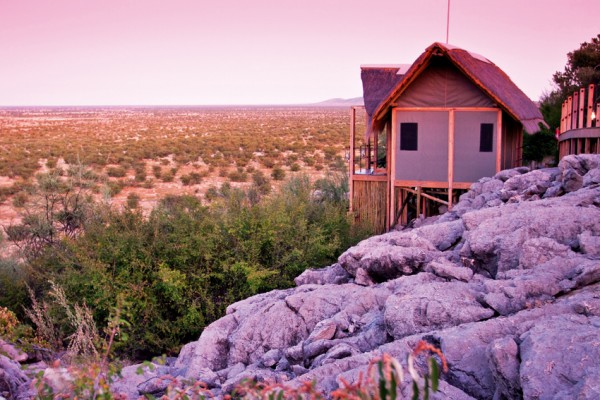
Dolomite Camp in the west has a microenvironment all of its own. Shaded by beautiful trees and home to some great birds, you can sit on your deck above the plains and spot the wildlife. The Dolomite environs are especially good for:
  • elephant herds, giraffe, zebra and other plains animals;
  • Leopards have been seen on the dolomite ridge and lions sometimes visit the waterhole;
  • This is the one place in Etosha where you can see baboons – they sleep on the neighbouring koppie;
  • Another special for Etosha is the mountain zebra, which you will often see here with Burchell’s zebra.


Okaukuejo Waterhole is a great place if you just want to sit in the camp and watch the passing parade – people, birds and animals. The antelope visit in large numbers when it’s mid-morning, and it can become quite busy.

Okondeka Waterhole in the north of Okaukuejo Rest Camp is great for seeing the resident lion pride. I counted 18 members at Easter and the second pride male was not at home. The plains animals have to drink at this waterhole, so just sit and wait for the action to come to you. I’ve seen a caracal hunting here mid-afternoon, and in March rare sightings of brown hyaena and honey badger were also recorded.

Halali Camp in the centre of the park offers accessibility to different kinds of waterholes.
  • If it’s cheetah you’re after, head 9 kilometres down to the pan and turn left following the pan edge to Sueda. If at first you don’t spot any cats, retrace your route on the way back to camp. This is a consistantly good area for cheetah sightings.
  • Or you could spend some time at Goas – a double waterhole east of Halali Camp that is often frequented by elephants, hyaenas and giraffe. Most animals come here to drink at some time (leopard, lions and rhino), so patience and a picnic are recommended.
  • Head from here north to Nuamses and wait quietly for the resident leopardess and her new cub. I saw and/or heard no less than four leopards around Nuamses late one afternoon in November last year.
Namutoni is feeling the drought this year, with Fischer’s Pan drying up and becoming somewhat smelly. Only a handful of permanent flamingos are holding out here – the breeding season never took place this year due to poor rains.


The 15 kilometres of sandy track through the forest to Onkoshi Camp is a delightful secret place and we’ve recently seen fresh tracks of lion, elephant and rhino here. Fellow visitors spotted a leopard just outside the camp before sunset. Apart from the big boys, it’s teeming with warthogs, kudu, steenbok, zebra and giraffe, to name a few. Drive slowly to take it all in.


WHAT’S FLOWERING?
  • Acacias!
  • If you see small acacia bushes in bloom with their bright yellow balls you’re looking at Acacia nebrownii, unaccountably called the ‘water thorn’! These bushes are often found in such dry areas you would never guess their presence indicates underground water.
ALSO WATCH OUT FOR:
  • Euphorbia damarana, which starts flowering in May, and is seen in the desert en route to Swakopmund
  • Combretum platypetalum (red-wing combretum), conspicuous in the yellow winter grassland in Caprivi
  • Dombeya rotundifolia (wild pear), seen flowering (covering the tree ) at the restaurant of the Waterberg Plateau Park well into winter.
ALOES

IN THE SOUTH
  • Aloe dichotoma (quiver tree) during June and July
  • Aloe gariepensis, which starts flowering in July to September
IN THE CENTRAL REGION   
  • Aloe littoralis (Windhoek aloe), which flowers in April/May in Windhoek, later in other parts
  • Aloe hereroensis, which flowers from July onwards
  •  Aloe asperifolia, seen along the road to Swakopmund, can flower as late as July


IN THE FAR NORTH-EAST
  • Aloe chabaudii, which flowers from May to July
WINTER BIRD-WATCHING
Look out for the small population of blue cranes that live in eastern Etosha. They can often be seen near Salvadora waterhole or along the pan towards Namutoni. They will be foraging at this time with one or two chicks from the summer breeding season. Their numbers total a scant 65.
After summer a small population of flamingos remain year round at Fischer’s Pan. This year the rains were insufficient to initiate the migration from the coast and subsequent breeding. So this year is a good time to see thousands of flamingos in the Walvis Bay Lagoon!
Winter birding is generally good in Namibia even after the summer visitors have left. When the trees are bare and food is scarce, it generally becomes easier to spot birds.
Look out for some of our endemic species:
  • Monteiro’s hornbills at Waterberg Plateau Park
  • Bare-cheeked babblers, Carp’s tits and White helmet-shrikes in Halali Rest Camp
  • Dune larks at Elim Dune, east of Sesriem Camp, early in the morning
  • Damama terns at the coast around the Walvis Bay Lagoon
  • Hartlaub’s francolins at Dolomite Camp, western Etosha

Thursday, April 21, 2016

Affordable luxury at the Entrance to Etosha National Park

Etosha Village

Prime destination for nature lovers combined with excellent service and cuisine! Etosha Village, uniquely combines affordability with comfort and delivers the perfect safari style experience in a private and protected reserve directly adjacent to the Etosha National Park, near Okaukuejo.
At Etosha Village nature and luxury are in perfect harmony through design and comfort. Besides the 40 accommodation units and Camping facilities, Etosha Village has three restaurant seating areas, a unique bar with a big screen television, a sparkling pool plus two kiddies pools as well as a well-stocked utility and curio shop.
The individual canvas suites offer a fully air-conditioned bedroom with a unique semi-open en-suite bathroom and a patio to enjoy the beauty that surrounds you.
The Etosha Village Camp Site is nestled in the spectacular green and gold Mopani forests surrounding Etosha National Park, and caters for both Groups as well as individual travellers.

The Etosha Village Camp Site is nestled in the spectacular green and gold Mopani forests surrounding Etosha National Park, and caters for both Groups as well as Individual travellers.

The 2 spacious Group Camp Sites are ideal for larger groups and can accommodate a maximum of 25 – 30 tents. These sites are equipped with Power Outlets, Running Water, Lights, Barbeque area and separate Ladies and Gents Bathroom facilities each featuring toilets, wash basins and showers.
The 4 Individual Camp Sites are also equipped with Power Outlets, Running Water, Lights, Barbeque and a well-kept shared ablution. 


Inspiring cuisine can be enjoyed at the Etosha Village Restaurant situated walking distance from the Camp Site. On-site facilities include swimming pools and a bar area with a big-screen television as well as a fully stocked utility and curio shop. Guided excursions to Etosha and sundowner drives can also be booked at reception.

Monday, April 11, 2016

A fossil adventure at Mesosaurus

Plan for a fossil adventure 40 km from Keetmanshoop, where you can join a short tour to view the ancient Mesosaurus fossils, overnight in the peaceful Namibian countryside and wander through a quirky quiver tree forest.


We had driven through several farm gates, passing a herd of goats that eyed me inquisitively, before reaching an arrow-shaped hill and a mountain dotted with broccoli-shaped quiver trees. He continued:  “While I was working on the tractor, my ten-year-old son noticed a rock with marks on it and brought it over to me. I hit it on a crack and it fell open, revealing a piece of fossil.”
Initially Giel thought it was a salamander fossil. He showed it to his brother-in-law, a zoology professor at Stellenbosch University, who took the sample with him back to the university. There, Dr Oelofson, who had studied the fossils extensively for his PhD thesis, identified it as an animal from the genus Mesosaurus, a small creature that resembled a crocodile with a long snout and long, needle-like teeth.

ANCIENT HISTORY

Giel briefly condensed millions of years of geological history into a few short minutes and explained that 320 million years ago southern Africa, then part of the supercontinent of Gondwana, was covered with a thick layer of ice. As the weather warmed, the ice started to melt and formed a shallow inland sea covering what is southern Africa and South America today. According to Giel, Mesosaurus lived in this shallow sea 270 million years ago and is considered to be one of the oldest reptile fossils found in southern Africa. It died out approximately 250 million years ago – long before the dinosaurs disappeared around 65 million years ago.
I marvelled at this infinite Earth journey as the wind blew the bleached grass around us into a butter-coloured sea. Standing next to the grave of a German colonial soldier buried on the farm in 1904 after altercations with the Nama in the area (relatively recent history), Giel showed me a rock that had cracked open exactly along a fissure – like a crystal geode – to reveal two perfect parts of a fossil. “You are welcome to take photos”, he told me and laughed. “It’s not often that you see two fossils in a fossil’s hand,” he said, referring light-heartedly to his advanced age.
He also pointed out coprolite, fossilised excrement, which under a microscope reveals what these creatures had eaten for breakfast so many millennia ago.
Before we moved on, Giel added some fascinating information about the Mesosaurus fossils that have been found both in southern Africa and South America. They are evidence that the two continents were once joined as one landmass and thus support Alfred Wegener’s theory of continental drift.

QUIVER TREES & ROCK MUSIC

The fun-filled tour was by no means over yet. We carried on along the farm road until we reached a quiver tree forest where the trees grow abundantly among dark dolerite boulders. The sun generously coated the landscape in a wash of gold as we wandered through the hardy aloe trees. Giel continued to educate me by telling me about the dolerite that had bubbled up as magma below the surface of the earth, before cooling off – and the quiver trees, their hollow branches once used by the early hunter-gatherers to make quivers for their arrows. Small pockets of trees grace southern Namibia and the arid Northern Cape in South Africa.
“I want to play you some music on the rocks.” Giel stood in front of two large slabs of dolerite, surrounded by quiver trees, black rocks and a vast blue sky that was quickly turning into a pastel masterpiece. While I gawked incredulously from a short distance away, he picked up a small stone and began to play the popular tune of Frère Jacques, followed by Nkosi Sikelel’ iAfrica. I stood in awe as the hollow sound rang clearly through the quiet afternoon and I hummed the words to myself. Yes, God bless Africa.
He broke my reverie, turning around with his blue eyes shining. I applauded. “You know, I’m not a very good musician,” he said humbly. “I’ve played these rocks for ten years now and can only play two songs!”
The sun dipped and the colours deepened around us. The short stop at the Mesosaurus Fossil Site had been a highlight of my trip to southern Namibia, a mix of exciting discovery, like unearthing an old treasure-chest full of gold doubloons, and a celebration of this unusual arboreal arena – with an amusing guide to add to the experience.
I had yet to overnight in the rustic and charming chalets under a star-studded sky and to wake to the melodic call of Namaqua sandgrouse on their way to the waterhole. Yet, I wanted to keep the experience somewhere safe in the recesses of my memory. I wouldn’t be able to preserve it for 250 million years, but I wanted some of the simple, natural magic to linger with me for a while longer.


Friday, March 18, 2016

Pick an Adventure...

Land, air and water-based adventures include quadbiking, 4x4 trails, hiking, birding, skydiving, kayaking, windsurfing and kite boarding along the coast.
The adventures don't stop there. Getting introduced to indigenous people whose cultures are unrecognizable to most of the world, eating mushrooms as they emerge from termite mounds, being mesmerized by ancient rock art work at Twyfelfontein, Namibia's only World Heritage Site, and taking time to listen to the silence are amongst the adventures of the mind, body and soul awaiting you in Namibia. 

Land:

4x4
Although Namibia is easily accessible some regions do lend themselves to some serious "off-roading" drivers need to know their stuff. These 4x4 experiences are offered as either guided or self-drive tours, with some off the best found in the sand of the Namib Desert. Operators like Coast Way Tours offer guided self-drive tours all the way from Luderitz to Walvis Bay, exploring the barren sandy coast.
Slow driving over rocky tracks, sandy stretches and plenty of sunshine are conditions that should be expected. The same goes for ending the day with a beautiful campfire and lively discussions.


Birding
For the enthusiastic birder to Namibia, the vast variety of both resident and migratory birds can only be exciting. Most bird species favor specific habitats above others and thus Namibia is blessed with a variety of birding destinations where the keen twitcher can satisfy their interests by sighting and recording new species. Some species are sighted more regularly when water and food sources are not in abundance, however some locations like Etosha are much more viable for birding during the rainy season than that of game viewing. Stable water sources during the early months of summer are always a good choice for a serious day of birding.
Birding is popular all over Namibia even among locals, thus be comforted that it is an activity available across the country. Some major birding locations include Etosha National Park, Waterberg Plateau, the Caprivi and northern river systems, as well as the coast, with spots like Sandwich Harbor and Walvis Bay lagoon. The Namib Desert offer great opportunities for sighting rare endemics like the Herero Chat and Dune Lark. In general, birding is very adequate in the country providing from the smallest, Scaly Feathered Finch to the heaviest flying bird, the Kori Bustard.
 
Caving
Over 120 caves have been registered in Namibia, the various environments providing plenty of adrenaline-inducing and educative experiences. The longest and only tourist' (because of on-site facilities) cave in Namibia is Arnhem Cave, with slightly over 4,800 meters total passage length and intersect groundwater. The cave is very dusty and dry, with almost no secondary cave formations. Visitors are allowed only torches or cave lamps to negotiate Arnhem's large chambers and winding passages. The lack of development causes minimal disturbance of the extensive and diverse bat population, which also ensures the conservation of several unique invertebrate species. Six species of bats have been recorded at Arnhem, including the giant leaf-nosed bat. Overnight accommodation is available at the site.
A national monument and the third largest cave in Namibia, the Gaub Cave in the Otavi Mountains can be visited on the Ghaub Guest Farm, from where tours are organized with a designated guide, minor's lamp and safety helmet. The Gaub cave is 38 meters in depth with 2.5 km of chambers and passageways. Petrified waterfalls, organ pipes, rock curtains and interesting crystal growths are some of the features to be seen.
Dragon's Breath, near Tsumeb, is another well-known cave, hosting the world's largest underground lake. Cave diving can be done here, but it's only accessible for professional and well-equipped cavers.
Another well-visited cave of a totally different nature is Phillip's Cave in the Erongo Mountains north of Karibib. Containing a famous rock painting of a white elephant and many others, it is surrounded by an evocative rock formation, called Bull's Party, due to its semblance to a group of conferring bovines.
Permission from the landowners is required to visit other caves in Namibia, with visits to certain caves requiring official permits. Visitors are recommended to wear industrial dust masks when visiting caves with thick deposits of dry bat guano. Since bats are of great ecological importance, visitors are asked not to disturb them, particularly during the wet season (January - April) when bats are breeding.
Cave disease (histoplasmosis) has not been recorded from any Namibian caves. Prospective visitors, particularly if they come from countries with histoplasmosis, or visit Namibia after caving in such countries, are therefore requested to ensure that all their equipment is cleaned and sanitized before entering Namibia. Such simple precautions may keep Namibian caves uninfected and safe for casual visitors.


Endurance
Adventure racing, often in the form of extreme running, is extremely popular in Namibia. Races vary in length, challenge and region but are generally for adventurous residents and tourists looking to push their physical limits. Below is a list of the top adventure races:
The Rock: Spitzkoppe Run and Bike Challenge is a foot-and-cycle race around the Spitzkoppe in the Namib held each year in September. There are various categories including half-marathon running, walking events and 25 and 70km cycle races. The event celebrates the natural beauty of the Spitzkoppe and surroundings and proceeds go to the local community.

100km of Namib Desert: Is a century race (100 km) that can subject runners to extreme conditions such as sandstorms, strong winds, blistering heat during the day and freezing temperatures at night. It takes place during December in the Sossusvlei area.

Namib Desert Challenge: Regarded as one of the toughest footraces on earth, this race covers 228 km of inhospitable, desert terrain. It is held in the Sossusvlei area, and includes five stages of high-endurance ultra-running, with competitors carrying their own survival kit and food. The competition takes place in March and can only host 80 participants.

Namibian 24-hour Ultra Marathon: The race is over 126 km, starting at the foot of the Brandberg and finishing at Jakkalsputz at the coast, crossing large areas of the most hostile desert coastline in the world the Skeleton Coast. The race usually takes place in April.
Lucky Star Marathon: The marathon takes place every year in October between the coastal towns of Swakopmund and Walvis Bay. Through this race, the organizers aim to promote community involvement and the benefits of a healthy lifestyle among Namibia's youth. Consequently significant focus is placed on involving schools across the country.

Old Mutual Victory Race Series: This race is run in four different legs in categories of either 5km or 21 km, in Oshakati, Swakopmund, Keetmanshoop and Windhoek.
Aussenkehr Desert Extreme Trail Run: This three day 100 km desert run takes runners along the banks of the Orange River, into the mountain country of Namibia, across the harsh plateaus and through ancient and enchanting canyons. It is usually held from the end of June to the beginning of July.

Fish River Marathon and Cycle: Participants can choose between a 104 km cycle, 54 km cycle, 42.2 km marathon, half marathon, 10 km fun walk, 30 km fun horse ride, or a 3 km kiddies and parent fun walk. Through the marathon, runners can qualify for the Two Oceans and Comrades marathons in South Africa. It commences from the Keetmanshoop 1Stop Petrol Station and is usually held in October.
Fish River Challenge: Runners are expected to support themselves throughout a 100 km run in 24 hours. The race begins at the top of the Fish River Canyon and finishes at the Ai-Ais hot springs. It usually takes place in August.

Geology
Namibia's varied geology encompasses rocks of Archaen to Phanerozoic age, thus covering more than 2600 million years of earth history. Nearly half of the country's surface area is bedrock exposure, while young surficial deposits of the Kalahari and Namib Deserts cover the remainder.
Geology is a topic travelers will find in discussion on any tour in Namibia, however meant for the laymen enthusiast. For the novice or fanatic, most tour operators provide custom tours focusing on the detailed side of Namibian geology, while enjoying all the rest the country has to offer. 

Hiking
Because of the high summer temperatures, tough terrain and lack of water, hiking in Namibia requires careful planning. That said, a wide-variety of walks, overnight hiking trails and guided wilderness trails are available for those looking to see the sights on foot.
Public routes are often subject to various regulations, which are listed with the description of the trails in the dropdown above. A fee is due for most trails in national parks. Hiking trails as well as accommodation at the rest camps should be booked well in advance.


Horse Riding
For accomplished riders there are several adventure options, including the Namib Desert Ride of about 400 km starting in the Khomas Hochland and leading through the Kuiseb Canyon, Tinkas, Tumas and Welwitschia Plains, Moon Valley, the seasonal Swakop River and coastal dunes to the Atlantic Ocean.
The Greater Fish River Canyon Ride traverses three private parks: Fish River Canyon Park, Gondwana Park and Aussenkehr Park, combining dramatic canyon landscapes, spacious desert plains and the mighty Orange River, covering between 2050 km per day over eight and a half days. The Fish River Canyon Ride takes three and a half days of riding through the second biggest canyon in the world where zebra paths, steep tracks, savannah grasslands and rocky tributaries form part of the path.
The Desert Horse Ride is a more relaxed ride, guided by Dr Telan Greyling, a botanist and world authority on the wild horses of Namibia. The 4-day circular ride traverses Sperrgebiet Rand Park, a private reserve adjoining the Sperrgebiet National Park, and habitat of the wild horses.
On the Damara Elephant Ride, which takes six and a half days through vast open spaces on horseback, riders can expect to see elephant, giraffe and rhino in a desert habitat, ancient craters and remnants from prehistoric times, not to mention the forbidding Skeleton Coast. These trails are all offered by the Namibia Horse Safari Company. 

The Desert Homestead 35 kilometres from Sossusvlei, offers accommodation in rock chalets with views across the Nubib Mountains. Under the trade name Desert Homestead & Horse Trails, the enterprise offers horse trails into the surrounding plains and watercourses, including breakfast rides, sunset rides, a 4x4 Sossusvlei excursion, an introductory ride, sleeping in the desert, and an optional sun downer ride. Packages that include the Skeleton Coast, Swakopmund and Grootberg are also available.
Grootberg Lodge also offers additional morning and afternoon rides. The horses at Grootberg hail from previously disadvantaged backgrounds, are tough as nails and totally unfazed by the sudden appearance of elephants. Most of them are Arab barbs bred in the area and bought from the donkey carts. River Crossing, 3 km outside of Windhoek en route to the international airport offers morning and afternoon rides, as well as full day rides, which include lunch at the foot of a cliff. The pace is varied and suited to the weakest rider in the group.
Horse trails at BaellsPort are geared to experienced riders as well as beginners, and include tailor-made overnight trails into the Naukluft with participants sleeping under the stars.
From just outside of Swakopmund, Okakambe Trails offers tailor-made overnight trails into desert terrains varying from sand dunes and rocky plains to mountains and dry riverbeds. The daily distance covered is approximately 30 to 40 km, depending on the experience of the riders and the weather conditions.
Okapuka Horse Safaris offers rides in close proximity to Windhoek. Riders can expect to be on horseback for between 4 to 5 hours per day on willing, forward going, responsive Arabian horses. Depending on time of arrival, it usually comprises of seven days of riding.
The Namibia Endurance Ride Association (NERA) holds regular endurance competitions throughout the country, and show jumping is also popular and is organized by the Namibian Equestrian Federation. Dressage and horse racing are more horse sports to choose from. 

Stargazing Together with Chile and Hawaii, Namibia is considered to be one of the top three destinations for stargazing in the world. With its generally cloudless night sky, especially in the dry winter months, minimal contamination by artificial light and air pollution, and excellent view of the southern constellations, Namibia has superb stargazing conditions. As such it is favoured by professional and amateur astronomers alike.
Namibia was chosen as the best site for the multi-national Max Planck High Energy Stereoscopic System experiment (H.E.S.S.), now fully operational on Farm Gaulschau near the Gamsberg. Many lodges have medium-sized telescopes (up to 16" diameter) for use by guests, and provide novice stargazing guests with a laymen's introduction to astrology.
The Khomas Hochland/Gamsberg area west of Windhoek has the third-clearest, least light-polluted sky in the world. An impressive 'farm' of telescopes and other equipment is maintained by the German-based International Amateur Observatory at the guest farm Hakos on top of the Gamsberg Pass, two hours' drive away from Windhoek.


Camping
Namibia is a camper's paradise. There are a medley of sights, smells, tastes and sounds to be experienced and enjoyed through camping in Namibia from the harsh, barren, stony plains around the Fish River Canyon, past the vast red dunes of Sossusvlei, along the wind-swept shores of the cold Atlantic Ocean to the seemingly endless plains and rocky mountains of Damaraland and the humid forests on the banks of the Zambezi River in Caprivi. Each corner holds a secret treasure of its own. There is a wide choice of sites all over Namibia for seasoned campers or nervous novices on their first camping holiday, from luxury campsites under shady trees and grassy lawns, to wild places under a camel-thorn tree in a sandy riverbed.
In recent years, there has been a growth in preference for conservancy or community campsites. These campsites, especially in the northwest and northeast of the country, have stylishly natural designs, and have been built with material from the area such as latte (sapling poles), reeds and thatch, with some being constructed creatively in boulder alcoves or on riverbanks. The majority have flush toilets and hot water, provided either by solar panels or the remarkably efficient wood-burning donkeys, and a shaded lapa area or kitchen counter with sink and wooden railway-sleeper counter tops. Others, in the watery north, have decks overlooking the river.
Camping holidays have become very popular and offer the traveler an inexpensive alternative to seeing Namibia. Many travelers spend most nights camping and using every 3rd or 4th night to refresh and spoil themselves in a more luxurious lodge and also to keep the rising expenses under control. Camping is a good alternative to discovering unexplored parts of Namibia and at the same time being in close contact to nature. Most car rental companies are offering the traveler a selection of camping equipment to take along on their journey. The country's weather conditions and the large selection of campsites throughout the country are ideal for the adventurous traveler.