Wednesday, June 15, 2016

New look for Namibian resort - Windhoek Country Club Resort

The Windhoek Country Club Resort, which is owned by Legacy Hotels and Resorts, has recently refurbished 26 of its bedrooms.
The bathrooms have been rebuilt and all rooms now have separate bath and showers. The rooms have new furniture, a fresh coat of paint, new wallpaper and fittings.
The remaining rooms will be refurbished in stages over the next few months to ensure guests’ comfort is not compromised.


Monday, June 13, 2016

Naankuse News


A constant need... for collars
It’s been yet another busy month for N/a’an ku sê’s rapid response team. Answering the call of the wild (and local farmers) the intrepid team leaped to action on 1 June, rushing to a farm where a resplendent leopard had been cage trapped, waiting to be fitted with a GPS collar and ultimately released back on the farmer’s land.  Weighing in at a whopping 85kg, this magnificent male soon joined the annals of our collared cats, his feline movements and behaviors being constantly monitored and shared with the landowner concerned.
The number of calls N/a’an ku sê receives is on the increase, the demand for collars growing by the day. Without these tracking devices we simply cannot keep up in our fight to prevent the unnecessary and tragic persecution of Namibia’s big cats – big cats who cannot speak for themselves, cannot stand up for their rights – their right to co-exist peacefully on the land they call home.

Monday, June 6, 2016

Winter – an ideal time to travel in Namibia


It’s that time of year again when Namibians pull out their winter woollies and seek the sun. Fortunately there’s plenty of sun at this time of year, because Namibia enjoys a summer rainy season, which means our winter days are clear and cloudless. 

Only a few tough farmers and lucky tour guides who have the good fortune to travel up north to warmer climes still bravely don their shorts in the morning. The rest of us dress up for the cold, but by midday we’ve all shed a layer or two and found a spot for soaking up the sun.


Our nights can become really cold though, with July usually being the coldest month in the interior. Right through winter you might well experience the famous east wind at the coast, which brings really hot weather.
There is lots to do in Namibia during winter and it’s a great time for travelling, so here are some tips to make the most of your stay and keep you warm, healthy and safe.


  • Insulate your geyser with a geyser blanket, then switch it off after showering in the mornings.
  • Pack a hot-water bottle for travelling. These are great for cold toes, as well as for stiff necks.
  • Open windows and doors by mid-morning to let in natural warmth, and close again before sunset.
  • Buy BUSHBLOK compact logs for your indoor fire, cooking or barbecue. Classified as smokeless fuel and manufactured by the Cheetah Conservation Fund in Otjiwarongo, you’ll be helping to conserve the natural environment for cheetahs in Namibia. www.bushblok.com
  • When staying in serviced accommodation such as hotels, let the staff know that you don’t need fresh sheets and towels every day. Because of our poor rainy season this year, Namibians are currently under pressure to be sparing with the country’s water resources.
  • Pick up at least one piece of litter a day – the more the better! Wild animals and birds are desperate for food after this year’s poor summer rainfall and will eat anything, which could end up killing them.
 
  • Even though it’s winter, because Namibia is very dry and since it’s sunny most of the time, you still need to keep well hydrated. Remember to drink water regularly, because as little as 2% dehydration can affect your concentration.
  • Pack in a good moisturiser for your face, hands and body, or buy one of the eco-friendly options available at Maerua Superspar’s health section. Better still, try Namibia’s own !Nara oil body (and food) products manufactured from cold-pressed !nara melon seeds, found in the Namib Desert.
  • Get enough exercise, especially when you’re sitting at a desk or in a car all day. Exercise enhances your mood, which counteracts the gloomier effects of the winter cold and the shorter days.
  • Even though this year has had a poor rainy season, we still need to be aware that there could be a risk of malaria. In certain areas a new generation of mosquitoes will have been bred, so it’s best to observe the prescribed prophylactic measures, particularly when travelling to northern Namibia.  


Etosha received late rains over Easter this year, so the area remains a risk zone.

SO:
–       Be sure to cover up after dark, especially your feet and legs (95% of mosquito bites are in these areas, and are inflicted while you’re standing or sitting).
–       Slap on mosquito repellent if you’re going to be sitting outdoors.
–       Sleep under a mosquito net if you can.
–       Consider taking oral prophylaxis if you’re visiting malaria areas.


WINTER SAFETY:
  • Make sure your barbecue or braai fire is thoroughly doused before you go to sleep. The slightest breeze can scatter sparks and possibly cause a veld fire, especially now in the dry winter and upcoming spring months.
  • Always carry extra water in your vehicle, as you never know how long you may have to wait for help if you break down in a remote area. Exposure to sun and wind will dehydrate you quicker than usual at this time of year.
  • Always travel to remote areas in two vehicles. Hiring a 4×4 can give travellers a dangerously false sense of security and tempt them to leave the main track.
  • On gravel roads, keep a safe distance behind the car in front of you, as the dust can completely obscure your vision.
  • Remember that in Namibia we drive on the LEFT side of the road!


WINTER SHOPPING One of the things I love about winter is that I can make endless soups with the veggies that abound this time of the year. Pumpkin, butternut, courgettes, broccoli and cauliflower come to mind.

WINTER PACKING
The climate in winter is pretty consistent in Namibia. It really does have a bit of everything except rain. Having said that, if you’re visiting the extreme south, you might well encounter some of South Africa’s winter rainfall spill over.


Throughout the rest of the country, nights can be bitingly cold, especially if there’s a slight breeze. Days are generally warm, especially at lunchtime. The coast is often misty and cold, but could have very hot east-wind conditions.

For the most part, however, a typical winter’s day inland would need the following wardrobe:
  • Winter pyjamas (warm socks if you’re camping!)
  • Beanie, scarf and a warm jacket for early-morning walks and drives
  • Closed shoes and socks for travelling and walking; flip-flops for relaxing
  • T-shirt, shirt, light jacket and jeans (for layering during the day)
  • A swimming costume for when you visit the northern regions
  • Sunglasses for the glare and a sunhat to prevent sunburn
  • Sunscreen – we have between 10 and 11 hours of sunshine per day in winter with no clouds, so there’s nowhere to hide!


WINTER GAME VIEWING
After the rains that fall to a lesser or greater extent during summer, the grass by winter has become quite flattened and the bushes thinner, resulting in better visibility for spotting game along the roadsides throughout Namibia. Because of the drought this year, towards the end of winter you may see nocturnal creatures such as bat-eared fox and aardvark foraging well before sunset. Add to this the fact that animals in Etosha must visit waterholes every day to drink and there’s no better time for game viewing.


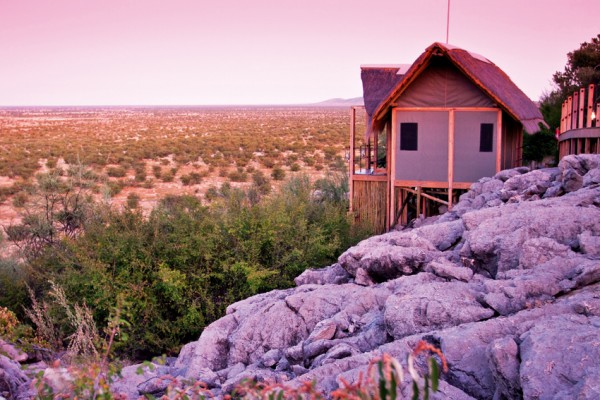
Dolomite Camp in the west has a microenvironment all of its own. Shaded by beautiful trees and home to some great birds, you can sit on your deck above the plains and spot the wildlife. The Dolomite environs are especially good for:
  • elephant herds, giraffe, zebra and other plains animals;
  • Leopards have been seen on the dolomite ridge and lions sometimes visit the waterhole;
  • This is the one place in Etosha where you can see baboons – they sleep on the neighbouring koppie;
  • Another special for Etosha is the mountain zebra, which you will often see here with Burchell’s zebra.


Okaukuejo Waterhole is a great place if you just want to sit in the camp and watch the passing parade – people, birds and animals. The antelope visit in large numbers when it’s mid-morning, and it can become quite busy.

Okondeka Waterhole in the north of Okaukuejo Rest Camp is great for seeing the resident lion pride. I counted 18 members at Easter and the second pride male was not at home. The plains animals have to drink at this waterhole, so just sit and wait for the action to come to you. I’ve seen a caracal hunting here mid-afternoon, and in March rare sightings of brown hyaena and honey badger were also recorded.

Halali Camp in the centre of the park offers accessibility to different kinds of waterholes.
  • If it’s cheetah you’re after, head 9 kilometres down to the pan and turn left following the pan edge to Sueda. If at first you don’t spot any cats, retrace your route on the way back to camp. This is a consistantly good area for cheetah sightings.
  • Or you could spend some time at Goas – a double waterhole east of Halali Camp that is often frequented by elephants, hyaenas and giraffe. Most animals come here to drink at some time (leopard, lions and rhino), so patience and a picnic are recommended.
  • Head from here north to Nuamses and wait quietly for the resident leopardess and her new cub. I saw and/or heard no less than four leopards around Nuamses late one afternoon in November last year.
Namutoni is feeling the drought this year, with Fischer’s Pan drying up and becoming somewhat smelly. Only a handful of permanent flamingos are holding out here – the breeding season never took place this year due to poor rains.


The 15 kilometres of sandy track through the forest to Onkoshi Camp is a delightful secret place and we’ve recently seen fresh tracks of lion, elephant and rhino here. Fellow visitors spotted a leopard just outside the camp before sunset. Apart from the big boys, it’s teeming with warthogs, kudu, steenbok, zebra and giraffe, to name a few. Drive slowly to take it all in.


WHAT’S FLOWERING?
  • Acacias!
  • If you see small acacia bushes in bloom with their bright yellow balls you’re looking at Acacia nebrownii, unaccountably called the ‘water thorn’! These bushes are often found in such dry areas you would never guess their presence indicates underground water.
ALSO WATCH OUT FOR:
  • Euphorbia damarana, which starts flowering in May, and is seen in the desert en route to Swakopmund
  • Combretum platypetalum (red-wing combretum), conspicuous in the yellow winter grassland in Caprivi
  • Dombeya rotundifolia (wild pear), seen flowering (covering the tree ) at the restaurant of the Waterberg Plateau Park well into winter.
ALOES

IN THE SOUTH
  • Aloe dichotoma (quiver tree) during June and July
  • Aloe gariepensis, which starts flowering in July to September
IN THE CENTRAL REGION   
  • Aloe littoralis (Windhoek aloe), which flowers in April/May in Windhoek, later in other parts
  • Aloe hereroensis, which flowers from July onwards
  •  Aloe asperifolia, seen along the road to Swakopmund, can flower as late as July


IN THE FAR NORTH-EAST
  • Aloe chabaudii, which flowers from May to July
WINTER BIRD-WATCHING
Look out for the small population of blue cranes that live in eastern Etosha. They can often be seen near Salvadora waterhole or along the pan towards Namutoni. They will be foraging at this time with one or two chicks from the summer breeding season. Their numbers total a scant 65.
After summer a small population of flamingos remain year round at Fischer’s Pan. This year the rains were insufficient to initiate the migration from the coast and subsequent breeding. So this year is a good time to see thousands of flamingos in the Walvis Bay Lagoon!
Winter birding is generally good in Namibia even after the summer visitors have left. When the trees are bare and food is scarce, it generally becomes easier to spot birds.
Look out for some of our endemic species:
  • Monteiro’s hornbills at Waterberg Plateau Park
  • Bare-cheeked babblers, Carp’s tits and White helmet-shrikes in Halali Rest Camp
  • Dune larks at Elim Dune, east of Sesriem Camp, early in the morning
  • Damama terns at the coast around the Walvis Bay Lagoon
  • Hartlaub’s francolins at Dolomite Camp, western Etosha

Friday, May 20, 2016

Windhoek Accommodation


Sweet Thorn Retreat Airport Lodge is located half-way between Windhoek and Windhoek Hosea Kutako International Airport, about 20km from the centre of Windhoek on the M53 road, Plot 65 Kapps Farm. The lodge's elevation offers a greater view of the Seeis Valley and surrounding Finkenstein Mountains, and boast 10 en-suite double rooms, 7 fully equipped tents and 3 spacious Campsites.

Lounge, Bar and Dining Room for Lodge Guests, Wi-Fi in the lounge area, Barbeque Facilities, Kiddies Club, Small Library, Malaria Free, Mobile Connectivity, Pool, Restaurant, Secure Parking

Three Rooms:  inside the Lodge main building, simply styled and furnished, one with 2 double beds, another with 3/4 size double beds and last one with twin beds
Seven Rooms: Outside main building, each have two 3/4 size beds next to each other

All the rooms are Air conditioned, walk-in en-suite shower facilities, a coffee/tea station

Seven Tents with bedding, kettle, crockery and cutlery,table and chairs, sharing ablution facilities - 2 showers, 3 WCs. Towels are not provided.

Three Large Campsites with electricity, lighting, braai area with grid, sharing ablutions - 2 showers, 2 WCs.

The dining area has a fully stocked bar and overlooks the pool area. Above this is an open viewing deck for guests to enjoy sun downers and stargazing. Quite often some of the antelope (waterbuck, blesbuck and springbuck) can be seen down at the floodlit waterhole.

small playground where the youngsters can be entertained while adults enjoy an afternoon barbecue. Swimming Pool exclusively for use by Lodge Guests.


Wednesday, May 18, 2016

Namibian lodge upgraded

Ichingo Chobe River Lodge on Impalila Island in Namibia, has been upgraded.

The lodge’s eight large air-conditioned Meru safari tents are set on a secluded island beneath a riverine canopy on the banks of the Chobe River. Each tent has a king-size bed, dressing table, bedside lamps, chairs and an en-suite bathroom.


Bathrooms have all been recently renovated with new floors, vanities, shower heads and taps.


Ichingo Chobe River Lodge offers a two- or three-night itinerary for guests and is suitable for families. Activities include game viewing by boat along the banks of Chobe National Park, an excursion through the beautiful Kasai Channel to view the Zambezi River, fishing, and a guided walk on Impalila Island.

Thursday, May 12, 2016

Hakusembe River Lodge scores big

What a success! Eco Awards Namibia assessed Hakusembe River Lodge for the first time and instantly honoured it with four desert flowers. The lodge of the Gondwana Collection on the banks of the Okavango River scored high marks for staff and health, social responsibility, management and legal compliance, building and landscaping, guiding as well as waste, pollution and sewer. Similar to the star-rating system for tourist accommodation, the environmental initiative awards up to five flowers for sustainability.


Gondwana combines its hospitality business with nature conservation and social commitment in a sustainable manner. Ever since the lodge group started in 1995 it bought farms in the vicinity of natural attractions, converted the farms into nature reserves and reintroduced game species which had once been indigenous to the area. 


Nature conservation is financed with the proceeds from the eco-friendly hospitality business, which in turn creates jobs and career opportunities for the local population.
In previous years Eco Awards Namibia repeatedly acknowledged Gondwana’s sustainability efforts with the highest seal of approval. Etosha Safari Lodge & Camp, Namushasha River Lodge, Canyon Roadhouse, Canyon Village, Canyon Lodge and Namib Desert Lodge have received five desert flowers each. The environmental endeavours at Damara Mopane Lodge were honoured with four flowers and those at Kalahari Anib Lodge and Kalahari Farmhouse with two flowers each. The lodges are up for reassessment this year (2016). Participation in the Eco Awards is voluntary.

Tuesday, May 10, 2016

Namibian drought threatens wild horses


The drought experienced in Namibia has severely affected the central and southern parts of the country with little grass left in the horses’ range, the Namibia Wild Horses Foundation has warned. 
Fences in the south and east restrict them from moving further inland to areas that received scattered rainfall.

The lack of rain has made it necessary to increase the feed to provide half to three quarters of the horses’ nutritional requirements. As much of Namibia is dry, grass and lucerne will most likely have to be bought from South Africa, which is a costly affair.

The horses have become one of the attractions in southern Namibia and thousands of tourists visit the Garub waterhole near Aus annually, to witness the horses galloping to the water across the Garub plains.
Namibia Wild Horses Foundation is appealing for funds or good quality grass for the winter period and urges the public to continue with their support for the wild horses to see them through the season.