Kaokoland is one of the last remaining wilderness areas in Southern Africa. It is a world of incredible mountain scenery, a refuge for the rare desert dwelling elephant, black rhino and giraffe and the home of the Himba people. Although it is harsh and offers little respite at midday, the rugged landscape is especially attractive during the early morning and late afternoon when it is transformed into softly glowing pastel shades.

The topography in the south of the area is characterised by rugged mountains which are dissected by numerous watercourses, but north of the Hoarusib River the scenery is dominated by table-top koppies. Still further north, the Otjihipa Mountains rise abruptly above the Namib floor to form the eastern boundary of the Marienfluss, while the west of the valley is defined by the Hartmann Mountains. The Marienfluss valley is very scenic and relatively greener than the Hartmann's valley. Hartmann's valley is closer to the Atlantic and yet much more arid. However, it does have a strange atmosphere when the sea mists drift inland

Kaokoland differs greatly from Damaraland in terms of accessibility and infrastructure. While quite a bit of Damaraland is isolated from the outside world it is really Kaokoland which is the back and beyond, silent, huge and for the most part empty. With 16,000 or so inhabitants, 5,000 of them Himba, Kaokoland has a population density of only one person to every two square kilometers which is about a quarter of the national average.
Kaokoland is bordered on the south the Hoanib River and on the north the Kunene River which also forms Namibia's border with Angola
Accommodation

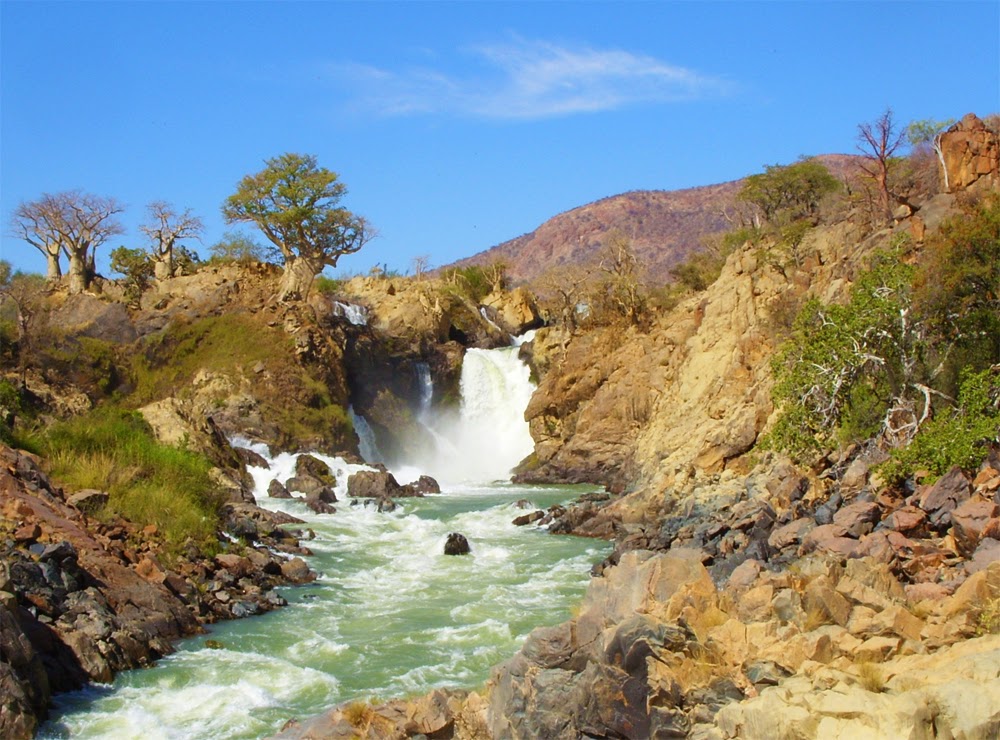
Right here, on the edge of this small desert wonder, is the very heart of Epupa, Epupa Falls Lodge. It has been here forever, since before the arrival of tour buses and self-drive adventurers from every nation across the globe. Back in the day, it was only a campsite with a fantastic view, now it is both lodge and campsite at one of the most marvelous places in Namibia.
Activities
1.Track desert-adapted rhino and elephnat with a qualified guide
2.Visit a Himba Settlement
3.Cool off in a rock pool at Eupupa Falls and some bird-watching.
4. Camp on the banks of the Kunene River
For more information please contact us at