Showing posts with label Namibia Reser Camps. Show all posts

Monday, September 8, 2014

About Us - Namibia Reservations

Namibia Reservations was established in 2002 and are situated in Germania Street 26 in Otjiwarongo. The closed corporation is run by owner Mark Mücke. 
Mark Mücke - Owner
The young and vibrant team at Namibia Reservations will be happy to assist you in all your travel requirements, bookings and requests; whether it is accommodation, air tickets, adventure activities, transfers, travel tips, conferencing, self drive tours, car rentals, group tours, fly in tours or granting you assistance with planning your own Namibia Safari. All the services rendered by us are carefully handled and planned in order to make sure that you will have the unforgettable holiday you always dreamed of.  We have a feedback facility on our website and look forward to receive your feedback so that we can constantly improve our service. 
 Meet the rest of the team!

Oliver Ahrens - General Manager
What this handsome brute loves most about his job is the different challenges brought forward to him every day.
Anzaan Fourie - Accounts Manager
 All things nature runs through her veins and she is most happy when outdoors. This loving personality could not be missed at first impression. Solving problems is her forte, and when in need of a shoulder Anzaan's door is always open.
Jolandie Koen - Accounts Assistant Manager
This charming lady has loved working with numbers since she could remember and there is no calculation she would not tackle. 

Jolitta Janse van Rensburg - Head of Consultants
This magnificent woman’s love is to work with her clients and to give them what they want.She love’s going the extra mile for them. 

Magret Mtileni - Tour Consultant
Above all things on earth Magret loves her family most. Her best quality is that she’s dependable. You can be sure to always have a smile on your face when being in the same room as Magret.
Michelle Kahikopo - Tour Consultant

This young-vibrant, happy-go-lucky Herero lady enjoy's lazing around on the sofa and watching her favorite TV programmes. The thing she loves most about her job is being apart of planning her clients' perfect holiday.
Millicent Kheimseb - Tour Consultant
 This ravishing African Queen loves music, spending time with family and friends, watching telly and her biggest love is traveling.  
Uaaruka Kandjii - Tour Consultant
This friendly face loves poetry, quotes and nature. She likes taking walks through her neighborhood. She describes herself as hard working, caring, loving and a role model to her siblings and son.
Virginia Both - Admin Clerk/Switchboard
This delicate flower loves to sing, play netball and socialize. Everyday-challenges is what makes this girl tick. 
Sarinda Du Toit - Creditors Clerk
 A conversation will never get dull when having it with this stunning personality, as socializing is what she loves most about her job. 
 
Kariza Kuhn - Debtors Clerk
This sublime young lady’s interests are the outdoors, but her heart lies with her family. This chirpy gal I have never seen without a smile, keeping the office in high spirits is her job. She loves working with people and always friendly and helpful.
Esmerelda English - Sales & Marketing Clerk
 This exquisite, fun loving person sees herself as a self-starter, a motivated and hardworking person. This enticing specimen loves reading, watching TV and most of all spending time with her family. 
Noellien Diergaardt - Sales & Marketing Clerk
 This superb fascination enjoys challenges and exploring new possibilities. She does not come short in encouragement and focus. When Noellien sets her mind to achieve a goal, she would go all out to retain the best possible outcome in her goal.

Friday, April 11, 2014

Namibia's Greatest Wildlife Sanctuary

Etosha National Park

 Etosha National Park is unique in Africa. The park’s main characteristic is a salt pan so large it can be seen from space. Yet there is abundant wildlife that congregates around the waterholes, giving you almost guaranteed game sightings. At the same time Etosha National Park is one of the most accessible game reserves in Namibia and Southern Africa.
The park is malaria free, accessible in a regular sedan car and the rest camps provide a range of accommodation as well as restaurants, viewing decks, shops and petrol stations. Luxurious camps in Etosha’s remote areas have now added top end accommodation to the park’s offerings.

 
About the Park:
Wildlife
The abundance of game in Etosha National Park is somewhat unexpected, showcasing some of the most common and rarest wildlife species. The areas with thicker vegetation are home to elephant (some of the largest in Africa due to the vitamins and nutrients found in the ground), the endangered black rhino and even leopard. Lions are camouflaged in the pale- golden colour of the grasslands, while giraffes rise- high above most of the dry vegetation.
Birders will love the rainy season in Etosha. After good rains the salt pan fills with water attracting a cloud of flamingos. More than 340 bird species have been counted in Etosha National Park. Among the migratory species, the European bee-eater is possibly the most popular sighting. The game reserve is also home to the world’s largest bird, the ostrich, and the heaviest flying bird, the kori bustard.
Please note that Etosha National Park is immensely popular, hence advanced bookings are recommended.

 Seasons:
During winter the Etosha Pan is bone dry. This endless white expanse is an unlikely venue for a wildlife sanctuary. The park is a wasteland of white dust which comes from the clay in the pan. Bushes along the road turn white as vehicles throw up dust and visitors who leave the park usually have a dusty aura around them! This is also the time when most of the visitors come to the park as the climate is mild and the wildlife concentrates itself at the waterholes.  Yet the surrounding areas overflow with springbok and zebra.
The summer in the park is vastly different with heavy rains turning a dry dusty Etosha National Park into a lush green oasis. This time of year means life in the park for new born animals as well as birdlife. Many European migratory birds come south to enjoy the new life that has been washed into the vegetation. Driving during the rainy season can get a lot trickier as roads can be flooded and having an equipped vehicle will make the journey a lot more enjoyable. It is also advised to do a lot more driving to view the wildlife as animals tend to keep clear of the once active waterholes that posed such dangers during the dry season.
Galton gate was exclusively used for Dolomite visitors. It is now open to all visitors to use.

For More info contact us at : info@namibiareservations.com
 Visit our website at: www.namibiareservations.com 
Check Out the Etosha Accommodation:  http://www.namibiareservations.com/etosha.html

Wednesday, February 5, 2014

Namibia Reservations Tour Consultant Office Chatter

Some chatter from our consultants and their daily office lives. Here is what they have to say and also a little bit of sillyness in th office.

The nicest to be a consultant:

When clients return from tour, and their feedback is positive. The comments clients give them makes them feel happy and that they did a good job.

When doing an itinerary, and the client ask consultants opinion and choosing to follow their advice over their own. That firstly gives the consultants the confidence about their knowledge and secondly creates a relationship between the client and consultant and makes the work so much pleasant.

And that in turn gives the consultant and makes the work so much pleasant. And that in turn gives the consultant motivations, to want to give advice to the clients


Wednesday, January 22, 2014

Etosha - The Great White Place of Dry Water

Etosha Pan – a vast expanse of desiccated white clay characterised by distant mirages and spiralling dust devils – that makes the game-viewing experience in the world-renowned Etosha National Park different to any other. In September 2007 the park celebrated its first hundred years of existence, the centennial celebrations taking place at the Namutoni Resort in the eastern section of the park.
The park was originally proclaimed as a conservation area in 1907 by German Governor Frederich von Lindequist. This entailed the region south, west and north-west of the pan and Governor von Lindequist named it Game Reserve No 2. (Game Reserve Nos 1 and 3 were established to the north-east and the Namib Desert respectively.) With subsequent additions Etosha became the largest game reserve in the world, extending over a vast area of approximately 80 000 square kilometres westwards across Kaokoland to the Skeleton Coast. However, for political considerations, it was progressively diminished in size until 1975 when it was reduced by 77 per cent to its present surface area of 22 912 square kilometres.
The definitive feature of the park is the Etosha Pan, an immense, shallow depression of almost 5 000 square kilometres of dry, white cracked mud, its flat surface broken only by shimmering mirages and the occasional animal wending its way across the empty wastes. It is this typical appearance that gave rise to the name in the local vernacular as ‘the great white place of dry water’. In the rainy season, fed by the Cuvelai system that has its origins in the highlands of Angola, floodwaters drain across Owambo. The pan fills with water and becomes an important breeding ground for migrant flamingos.Consisting of saline desert, savannah and woodlands, Etosha’s vegetation varies from dwarf shrub savannah and grasslands to thorn-bush and woodland savannah. Mopane, Colophospermum mopane, is the dominant tree species and is found in eighty per cent of the park. West of Okaukuejo a large stand of African moringa, Moringa ovalifolia, referred to as Sprokieswoud, Fairy or Phantom Forest, is the only location in Namibia where this interesting tree grows in a flat area.
A total of 114 species of mammals are found in the park, including the rare and endangered black rhino, cheetah and black-faced impala. Large mammals include giraffe, elephant, blue wildebeest, mountain and plains zebra, hyaena, leopard and lion.

Tuesday, September 24, 2013

Facts about the Morula Tree-Namibia

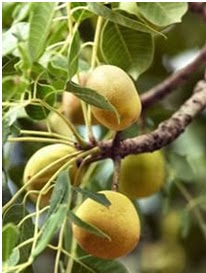
The marula is a fairly attractive deciduous tree that grows to a medium-size of around 7-18m. It has a broad, mostly straight trunk and a widely spreading, fairly dense, rounded crown. Old stems are fairly smooth and the bark peels off sporadically in rather large, flat, roundish discs exposing underlying yellowy bark. This in turn colours the old stems grey with yellowish patches.Leaves on the marula are compound with 3-7 pairs of leaflets and a terminal one 30-100 x 15-40mm. On young plants the leaves have toothed margins. The small flowers are pinkish-red in colour, and male and female flowers occur on separate trees and bloom September-November. The fruits are large and fleshy, up to 40mm in diameter and ripen yellow in January-March.


 The marula is a very busy tree indeed. The leaves are browsed by game and the bark is stripped by elephants. The fruits are edible and exceptionally high in vitamin C content and are eaten by livestock, game, monkeys, baboons and humans. They are used to brew an alcoholic drink and they make a delicious jelly preserve. The tasty nut-like kernels are also eaten by humans. The bark is used in traditional medicine and butterflies and moths breed on the tree. The timber is used for carving and firewood and the bark can be used to make a dye. Marula grows in a woodland habitat and can be found in the far north of  Namibia.
Some Lodges where this tree may be found:
Ondangwa Hotel, Oshakati Country Lodge, Ruacana Eha Lodge.


For generations, women in the Oshana, Ohangwena, Omusati and Oshikoto regions of north-central Namibia have been using it as a source of food as well as for its cosmetic properties. Inside the fruit is a large nut, which reveals two to four locules. When broken open, each contains an oil-rich kernel. With a skill handed down from generation to generation, rural women are able to remove these small kernels and squeeze out the oil. This they then use either as an ingredient to complement the taste and texture of traditional chicken and mahango dishes, or as a moisturiser on their skin.


Friday, July 15, 2011

New on Namibia Reservations website

Kamanjab Rest Camp

Kamanjab Rest Camp is situated in the fascinating Kunene Region in the North-West of Namibia, which is also the home of the Desert Elephants, the Damara and Himba people. Cool off in the Splash pool after a hot and dusty drive.
Spot the birdlife at the Rest camp from the nearby waterhole or from the “sundowner-koppie”. Here you can enjoy beautiful landscapes with rocky Hilltops, lovely grasslands and abundant wildlife.

For more details visit our website at www.namibiareservations.com/kamanjab_restcamp.html or email us to make a booking at info@namibiareservations.com