Showing posts with label Namibia Animals. Show all posts

Tuesday, May 22, 2018

Dik-Dik of Namibia


The Kirk's dik-dik  is a small antelope native to Eastern Africa and one of four species of dik-dik antelope. It is believed to have six subspecies and possibly a seventh existing in southwest Africa. Dik-diks are herbivores, typically of a fawn color that aids in camouflaging themselves in savannah habitats.  They are also capable of reaching speeds of up to 42 kilometers per hour. The lifespan of Kirk's dik-dik in the wild is typically 5 years, but may surpass 10 years.  In captivity males have been known to live up to 16.5 years, while females have lived up to 18.4 years.

Dik-diks are some of the world's smallest antelopes, with the largest, the Kirk's dik-dik, standing between 14 and 18 inches tall and weighing no more than 7.2 kg. Female dik-diks tend to be 1 to 2 pounds heavier than males. Dik-diks are dainty creatures with a pointed, mobile snout, large eyes and ears, prominent preorbital glands, pipestem legs, hare-like hind limbs that are significantly larger than their forelimbs, and a vestigial tail. Their coats, depending upon their habitat, range from grey to gray-brown with tan flanks, limbs, and an erectile head crest and whitish eye rings, ear lining, underparts, and rump".


Similar to other dwarf antelopes, Kirk's dik-diks exist in monogamous pairs on territories. Territories are marked with dung and urine that are deposited in a ritual that is performed to help helps maintain pair bonds. During the ritual, the female will excrete, followed by the male, which samples the female's urine stream to check her reproductive capacity. He paws over and then marks his dung and urine over her deposit. Finally, the pair marks nearby twigs with secretions from their pre-orbital glands. Kingon 1982 states that, "The male courts the female by running up behind her with his head and neck stretched and his muzzle pointing out in front. Copulation begins with the male standing on his hind legs behind the female and waving his forelegs at an acute angle to his own body in the air over her back". Copulation typically occurs anywhere between three and five times within a 9-hour period.


Monday, July 27, 2015

Doro Nawas Camp


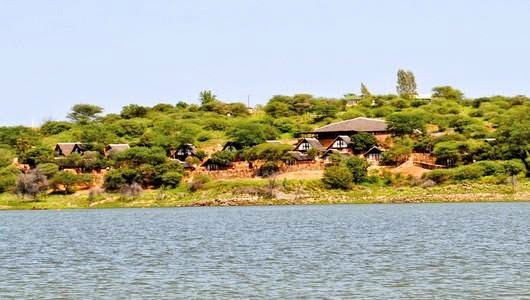
 Doro Nawas Camp is located in the dry Aba-Huab River Valley, within the Doro !Nawas Conservancy in central Damaraland, and commands spectacular views of the Etendeka Mountains to the north and the red sandstone cliffs of Twyfelfontein in the south.

http://namibia-luxury-accommodation.com/hotel/doro-nawas-camp/

Accommodation comprises 16 units: a mix of stone and canvas walls with wood and glass doors, shaded by a thatch roof. Each unit, designed to blend into the hillside, consists of a bedroom, en-suite bathroom (with outdoor shower) and a veranda for star gazing or sleep-outs. The main area is perched atop a rocky knoll offering unspoilt panoramic views from the indoor and outdoor dining areas, pool area, bar and a local curio area. A staircase to the flat roof leads to a place perfect for relaxing sun downers and star gazing.
 
 
The ancient Twyfelfontein San rock art engravings, a World Heritage Site, is close by.
Sleeping under the stars is a must in this pristine environment
An easily accessible base from which to see desert-adapted elephant
 
http://namibia-luxury-accommodation.com/hotel/doro-nawas-camp/
 
For more information please contact us at 

Monday, July 20, 2015

Amazing Destinations To See


Mahango Game Park
The Mahango Game Park (also known as the Mahango Game Reserve) is a protected area in Namibia within Bwabwata National Park. It is situated at the country’s eastern border with Botswana in the flood plains of the Okavango River basin, close to the Popa Falls on the river. The Caprivi Strip encloses the western part of the park. About two thirds of the bird species found in Namibia are located here as it includes both wetland and tropical terrestrial species of birds.

  
Coast
Swakopmund & Walvis Bay both possess a resort town atmosphere attracting both tourists and locals, offering plenty of opportunities to play in the surrounding dunes and ocean.
With miles upon miles of sandy beaches to explore, excellent fishing, fantastic water sport opportunities and plenty of sand dunes to climb.
 

Erongo Region
The eastern region, of the Erongo Region of Namibia, being of a semi arid landscape, has lent itself perfectly to become the farming hub of the region. The areas around the Karibib, Omaruru and Okombahe/Uis villages are well situated to combine communal farming and commercial farming.


Lüderitz
Lüderitz is a harbour town in southwest Namibia,lying on one of the least hospitable coasts in Africa.It is a port developed around Robert Harbour and Shark Island.The town is known for its colonial architecture, including some Art Nouveau work, and for wildlife including seals, penguins, flamingos and ostriches.

 
http://namibia-luxury-accommodation.com/location/southern-namibia/luderitz/

For more information please contact us at 

Wednesday, July 15, 2015

Villa Mushara

Villa Mushara is situated a mere 8 kilometers from the Von Lindequist gate of the world famous Etosha National Park, thus allowing the best of both worlds.


The rugged harsh wilderness of Etosha combined with the exquisite accommodation and cuisine of Villa Mushara offers a stark contrast, which has been depicted in the villas through the use of opposing textures.

http://namibia-luxury-accommodation.com/hotel/villa-mushara/

Each villa has its own unique ambience, designed with a classic appeal. Each fine detail has been considered within the confines of the 140 square metre living space, from a small private library in each villa to a silver candle snuff in the en suite bathroom.


You can relax in the private plunge pool or lounging in the “sala” that’s immersed in bush.  

http://namibia-luxury-accommodation.com/hotel/villa-mushara/

Villa Mushara is a place that will leave you yearning for more, long after your departure.

For more information please contact us at at 

Wednesday, May 27, 2015

Gorgeous places in Namibia

Day Trips From Windhoek

There are several recreation resorts and guest farms close enough to Windhoek in the Central Region for a day and weekend excursions.

Daan Viljoen
 
 
Daan Viljoen is a place that nature and wildlife lovers can explore, by means of self-guide, in safety on short game drive, walks and hikes.

Gross-Barmen Hot Springs
 
 
Gross Barmen is located around 100 km from the capital city of Windhoek, nestled on the banks of a tributary of the Swakop River. Set between rows of palm trees, green lawns and many pleasant walks, the resort is ideal for all ages. Gross Barmen includes facilities for spa & wellness, fitness, recreation, and leisure.


Von Bach Dam Resort is located on the outskirts of the Auas mountains and is filled by the Swakop river, acting as Windhoek’s main water source. It’s surroundings include Namibia’s most remarkable wildlife species. Von Bach offers all its guests the recreation and relaxation only nature’s finest can provide.

Hardap Recreation Resort

http://www.namibiareservations.com/marientale.html

This resort is situated at the Hardap Dam, Namibia's biggest reservoir. The resort is close to Mariental in southern Namibia and there is a game reserve is on the southern side of the dam. The route offers picturesque views of the dam, and is home to rhino, gemsbok, Hartmann's Zebra, kudu, ostrich, springbok and steenbok. Hardap lies 250Km south of Windhoek.

For more information please contact us at 

Wednesday, May 20, 2015

Okutala Etosha


Formerly known as Naua Naua Lodge, Okutala Etosha as undergone a complete renovation in 2013. The lodge is set on a hillside with spectacular views over the bush and wildlife. The lodge is about 25km from the Etosha National Park.


The rooms are designed to have the optimal balance between comfort, luxury and uniqueness. Each room presents itself with a somehow different decoration and atmosphere, but of course they all offer the same high standard.There are nine lodge rooms of which two have an extra single bed in an adjoining room and two have two extra single beds in adjoining rooms. All beds have mosquito nets for that extra peace of mind and sleeping comfort. With a choice of single, shared and family accommodation, Okutala Etosha has something for everyone.

At Okutala, an interesting range of outdoor diversions are offered to guests. Nature drives to view the free ranging animals on the farm, elephant walks, trips to watch the carnivores being fed, hiking, horse riding and mountain biking are all available, and the farm offers a number of specially designed hides geared towards the needs of photographers.
 

Okutala also offers leisurely-guided tours into the Etosha National Park to view an abundance of game, including four of the famous Big Five. Half-day and full-day excursions are available and include a delicious picnic lunch and drinks. Up to ten guests can be transported in the private safari vehicle at Okutala, and you will be encouraged to take your time viewing the animals and to snap as many photographs as you desire.

For more information please contact us at 

Friday, February 20, 2015

Home Away From Home

 Welcome to Okonjima, home of The AfriCat Foundation– the perfect African safari destination.

http://www.okonjima.com/content/The_Okonjima_story

Namibian safaris are truly wonderful and as The AfriCat Foundation rehabilitates cheetahs, wild dogs hyaenas and leopards, there are opportunities to see these beautiful carnivores in their natural environment.

 Things to Do: 
 
1.THE AFRICAT FOUNDATION: AfriCat is a non-profit organisation set up to conserve and protect threatened cheetah, leopard, and other wild carnivores of Namibia.

2.BUSHMAN TRAIL:
Experience a day in the life of a Bushman. It constitutes an easy walking trail and is highly informative.

3.GAME DRIVE: After dinner, guests are invited to join a guided, night-drive in the 20 000ha / 200km² private, nature reserves.
 
4.PHOTOGRAPHY:  With the abundance of animals and bird life and 
 spectacular scenery, Okonjima is a photographer’s paradise


 Accommodation

The Grand, African Villa:
The Villa overlooks a natural waterhole and is situated in a secluded wilderness area, approximately 10 km from our Base.


        For more information please contact us at: info@namibiareservations.com


Monday, January 26, 2015

Crazy Specials offered by Namibia Reservations

Namibia lies in the South West of Africa, just above South Africa and below Angola. To the east is Botswana and to the west is the Atlantic Ocean. Namibia is a sparsely populated country full of wide-open spaces including the spectacular Namib Desert and the bleak Skeleton Coast. Namibia is also rich in Wildlife and has the magnificent Etosha National Park - one of Africa's best game reserves.

We are currently having a special for all over nights done before 30.04.2015 at the following accommodation establishments !!!!!!

Swakopmund Hotel


Damara Mopane lodge

Sossus Dune Lodge


Nest Hotel

Twyfelfontein Lodge

C'est Ci Bon Hotel


Frans Indongo Lodge 

For more information and for more current special offers, please contact us via email at info@namibiareservations.com
Visit our website at www.namibiareservations.com

Wednesday, July 30, 2014

Wild Life in Namibia - Cats and dogs

Namibia's wildlife is a key reason why many visitors travel here, and below is a little information on some of Namibia's cats and dogs – concentrating on aspects that are specific to Namibia.


Lion
Africa's largest predator, the lion is the animal that everybody hopes to see on safari. It is a sociable creature, living in prides of five to ten animals and defending a territory of between 20 and 200km².
In Namibia, lions are occasionally reported in the Kaokoveld or in the Central Highlands, but Etosha and the Caprivi's parks are the most reliable places to see them. Occasionally, they used to find their way down river valleys and take seals on the coast as prey. However, there are no reliable reports of this in recent years.
 
 
Leopard
The powerful leopard is the most solitary and secretive of Africa's big cats. It hunts at night, using stealth and power, often getting to within 5m of its intended prey before pouncing.
Leopards are the most common of Africa's large felines, yet a good sighting in the wild is extremely unusual – in fact there are many records of individuals living for years undetected in close proximity to humans. They occur everywhere apart from the desert, though they favour habitats with plenty of cover, like riverine woodlands and rocky kopjes. Namibia's Central Highlands are perfect for leopard, which are common on the farms there. Some lodges, like Okonjima, encourage sightings by offering them food. 
 

Cheetah
This remarkable spotted cat has a greyhound-like build, and is capable of running at 70km per hour in bursts, making it the world's fastest land animal. A diurnal hunter, cheetah favour the cooler hours of the day to hunt smaller antelope, like steenbok and duiker, and small mammals like scrub hares.
Namibia probably has Africa's highest cheetah population – estimated at 25% of the world's population. This is largely due to the eradication of lion and spotted hyena from large areas of commercial farmland, where cheetah are not usually regarded (by enlightened farmers) as a threat to cattle. Etosha is Namibia's best park for cheetah in the wild, though there's probably a higher density of them on many farms.
 
Serval
The serval is smaller than a cheetah, but has a similar build and black-on-gold spots giving way to streaking near the head. Seldom seen, it is widespread and quite common in moist grassland, reedbeds and riverine habitats throughout Africa, including Owamboland, Etosha, Bushmanland and the Caprivi Strip. It preys on mice, rats and small mammals, but will sometimes take the young of small antelope.
 
Caracal
The caracal resembles the European lynx with its uniform tan coat and tufted ears. It is a solitary hunter, feeding on birds, small antelope and young livestock. Found throughout the subcontinent, it thrives in Namibia's relatively arid savannah habitats, and occurs everywhere except the far western coastal strip of the Namib. It is nocturnal and rarely seen.


African Wild Dog
Also known as the painted hunting dog, the wild dog is distinguished from other African dogs by its large size and mottled black, brown and cream coat. Wild dogs prefer open savannah with only sparse tree cover, if any, and packs have enormous territories, typically covering 400km² or more. They travel huge distances in search of prey and so few parks are large enough to contain them.
In Namibia wild dogs are sometimes seen in Khaudum or on the Caprivi Strip. Botswana's nearby parks of Chobe and Moremi are one of their last strongholds, and so they certainly move across the border. Attempts to reintroduce them to Etosha have so far failed.

Black-backed-Jackel
 The black-backed jackal is an opportunistic feeder capable of adapting to most habitats. Most often seen singly or in pairs at dusk or dawn, it is ochre in colour with a prominent black saddle flecked by a varying amount of white or gold. It is probably the most frequently observed small predator in Africa south of the Zambezi, and its eerie call is a characteristic sound of the bush at night. It is found throughout Namibia, excluding the Caprivi Strip, and particularly common in Etosha, where it is frequently seen inside the restcamps at night, scavenging for scraps.

Wednesday, July 2, 2014

About desert elephants.......

 Introduction

The desert elephants of Namibia’s Kunene Region are a distinctive population adapted to life in an extremely arid environment. They are one of only two populations of “desert” elephants in the world (the other is in Mali, North Africa) and have a number of notable physical and behavioral differences. There has been some speculation that desert elephants are a separate subspecies, but the movement of bull elephants between savannah areas like Etosha, and the desert, suggests that there is sufficient genetic exchange that they are not a unique subspecies. However, Namibia’s desert elephants are unusual in some of their learned behaviors, such as long-distance migration, that allow them to survive in this difficult environment.

Physical Characteristics

 Desert elephants are approximately the same body size as savannah elephants, although their bodies may appear less bulky, probably from a lower food intake. Their feet appear to be wider, probably as a result of walking long distances on sand, which causes the footpads to be splayed out.

A full-grown male (bull) elephant can weigh up to 6 tons (~6000 kg) and be 4m high at the shoulder. Females are usually a little more than half that weight.


Elephants are known to live 60+ years in captivity, but most probably have shorter lives in the wild. We do not know the exact ages of the oldest elephants in the desert population, but estimate that some may be 40-50 years old.

Elephants have only four teeth, one on each side of the upper and lower jaw. They grow six sets of new teeth throughout their lifetime, and may die of starvation in old age when they can no longer chew. 


Tusks are specialized teeth that continue to grow throughout an elephant’s lifetime. Tuskless-ness is an inherited trait that tends to run in family groups. The tuskless trait is found in some desert females, never in males, however both males and females are prone to tusk breakage, which may make them appear tuskless for a time, until the tusk grows out again. In the Hoarusib and Hoanib population, approximately 6 out of 20 females are tuskless.
Elephants eat almost any vegetation, including grasses, herbs, shrubs, leaves, bark, seeds, and fruit. Adult bulls can consume 250kg daily, although females eat less than that. During the wet season they prefer green shoots and buds, but in the dry season desert elephants will eat camelthorn (Acacia erioloba), mopane (Colophospermum mopane), and Ana trees and seedpods (Faidherbia albida).
Elephants prefer to drink daily, but can go up to three days without water if necessary. Bulls will drink up to 160 liters per day. Water, dust, and especially mud are sought out for bathing and coating the skin against sun and biting insects.

Elephants communicate with each other using scent, touch, and a variety of sounds, including low frequency rumbles (below the level of human hearing) that can travel 5-10km or more.


Friday, May 16, 2014

Beautiful Birds in Namibia

There are some 620 bird species native to Namibia. The national bird of Namibia used to be the Crimson breasted shrike (now known as the Crimson breasted boubou) as it's colours matched those of the Imperial German flag. However, as that is no longer politically correct the African fish eagle has now been named Namibia's national bird.

Crimson breasted shrike


Birds are the only animals with feathers. All birds have feathers and wings. As the fastest of birds can reach speeds of up to 160km/hr they can travel faster than any other animal. However, not all birds can fly, ostriches and penguins are both flightless. Instead of flying ostriches walk or run and only use their wings for balance. Penguins swim and use their wings like flippers.

Ostrich  
All birds hatch from eggs with most types of birds laying eggs in nests made by the female and her mate. The majority of birds have one mate at a time and some species keep the same partner for life. Birds belong to a large group of animals called vertebrates who have backbones. Woodland birds get their food from plants whilst others feed from small animals such as insects. Birds and their eggs in turn serve as food to rodents, foxes and snakes. Fruit-eating birds help spread seeds by eating the pulp of berries and other fruits and pass the seeds in their droppings, a feature common with some species of bats.


Every species has its own characteristic geographical range, which vary from local to worldwide. The distribution patterns can be established by mainly habitat extremes, as well as the ability to transit across unsuitable territory. Boundaries and habitats particular to Namibia include pans (Etosha), grassland, Nama Karoo, Namib Desert, succulent Karoo, Kalahari savannah and Kaokoland savannah. The Kavango (Okavango) River is a typical Okavango Delta swamp habitat.